





The Euro-spec i-MiEV can sprint from 0 to 100 km/h in 13 seconds and reach a top speed of 130 km/h according to the manufacturer. These realistic numbers would prove fast enough for the city-oriented microcar.
The perfect commuter?
The folks at Mitsubishi Canada are promising a range of 120 kilometres with a full battery charge. Obviously, most drivers should expect less since many factors can limit a car’s optimum range.
Let’s say you frequently drive in the hills that surround downtown Montreal, Vancouver or Toronto, and you rely on the air conditioning or heater, which consumes a lot of energy. The distance you will travel won’t be the same as on a flat highway without using the aforementioned accessories.
Charging the battery takes up to seven hours through a 200-volt/15-amp household outlet. With a regular 100-volt/15-amp outlet, the process would take 14 hours.
Mitsubishi will offer an optional three-stage system called Quickcharger. Plugged in a 200-volt outlet, it will restore 80 percent of the battery’s capacity in just 30 minutes. Even Mr. Ulmer claims that pricing will be "prohibitive," however, so this device will mainly be used by businesses.
What about the i-MiEV’s price?
That’s a good question. South of the border the i-MiEV will reportedly retail for about US$35,000, while the Nissan Leaf is announced at US$32,780.
In Japan, Mitsubishi sells the car for 4,380,000 yens, which is the equivalent of CA$52,000 using the current exchange rates. That’s a lot of money. Of course, just like Nissan, Mitsubishi Canada executives are hoping that our various levels of government will come up with incentives for new electric car buyers.
While these backstage games and lobbying play out, consumers can be excited about the low ownership costs of the i-MiEV, roughly a third of a traditional, gas-powered car’s. At least that’s what Mitsubishi is saying.
One thing’s for sure: you can forget about oil changes! Over the first 10 years, you will likely replace the tires, some lights, the front wipers, but that’s it! You may also have to realign the wheels… or change the rubber caps on the pedals. Not what I call "expensive" maintenance work…
After 10 years or 150,000 kilometres, the battery will still retain 80 percent of its original capacity. It could then be removed from the car and installed in your home to run appliances, predicts Mr. Ulmer.
Clearly, we have much to learn about the future relationship between urbanites and electric cars!
The perfect commuter?
The folks at Mitsubishi Canada are promising a range of 120 kilometres with a full battery charge. Obviously, most drivers should expect less since many factors can limit a car’s optimum range.
Let’s say you frequently drive in the hills that surround downtown Montreal, Vancouver or Toronto, and you rely on the air conditioning or heater, which consumes a lot of energy. The distance you will travel won’t be the same as on a flat highway without using the aforementioned accessories.
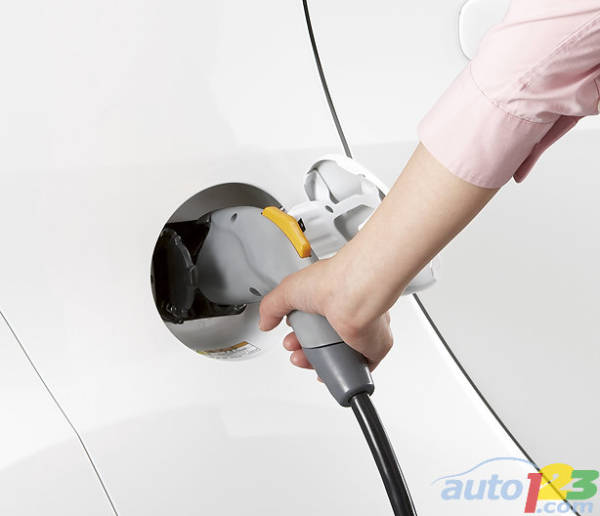
Charging the battery takes up to seven hours through a 200-volt/15-amp household outlet. With a regular 100-volt/15-amp outlet, the process would take 14 hours.
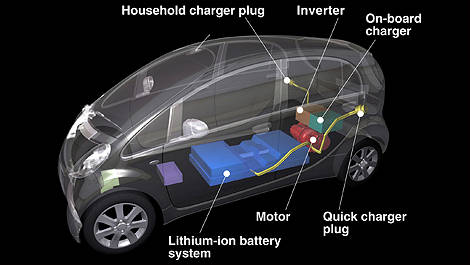 |
| The i-MiEV shares its mid-engine architecture with the conventionally-powered Mitsubishi i, sold in Asia and Europe. (Photo: Mitsubishi) |
Mitsubishi will offer an optional three-stage system called Quickcharger. Plugged in a 200-volt outlet, it will restore 80 percent of the battery’s capacity in just 30 minutes. Even Mr. Ulmer claims that pricing will be "prohibitive," however, so this device will mainly be used by businesses.
What about the i-MiEV’s price?
That’s a good question. South of the border the i-MiEV will reportedly retail for about US$35,000, while the Nissan Leaf is announced at US$32,780.
In Japan, Mitsubishi sells the car for 4,380,000 yens, which is the equivalent of CA$52,000 using the current exchange rates. That’s a lot of money. Of course, just like Nissan, Mitsubishi Canada executives are hoping that our various levels of government will come up with incentives for new electric car buyers.
While these backstage games and lobbying play out, consumers can be excited about the low ownership costs of the i-MiEV, roughly a third of a traditional, gas-powered car’s. At least that’s what Mitsubishi is saying.
One thing’s for sure: you can forget about oil changes! Over the first 10 years, you will likely replace the tires, some lights, the front wipers, but that’s it! You may also have to realign the wheels… or change the rubber caps on the pedals. Not what I call "expensive" maintenance work…
After 10 years or 150,000 kilometres, the battery will still retain 80 percent of its original capacity. It could then be removed from the car and installed in your home to run appliances, predicts Mr. Ulmer.
Clearly, we have much to learn about the future relationship between urbanites and electric cars!
Article Gallery