





Under the hood
The new 2.0-litre engine still retains Subaru’s horizontally opposed layout. However, it features a longer than normal stroke coupled with a smaller bore diameter to provide better filling of the cylinder and to get a bit more torque out of the same displacement. Intake tract, cylinder head and exhaust are all-new as well. Goals for this engine were improvements in fuel economy without sacrificing drivability. Horsepower comes in at 148 while torque maxes out at 145 lb-ft.
Fuel economy improves by 8% and emissions have been reduced to meet the up and coming 2016 standards. To do this, Subaru engineers have moved the catalyst up to the exhaust manifold while adding various friction reducing devices such as roller rocker arms, and utilized better flame propagation in the smaller bores for more complete combustion.
In addition, the EGR (Exhaust Gas Recirculation) system temperature is now controlled by a cooling system that utilizes engine coolant. Benefits are that the engine heats up faster which reduces the amount of pollutants issued at start-up.
Subaru will offer a standard five-speed manual gearbox on all models, which gets new gear ratios to better match the 2.0-litre engine’s power characteristics. Subaru’s second-generation CVT automatic will be optional in all models as well, while paddle shifters will be included with the CVT in all but the base 2.0i trim.
Suspension
The devil is in the details and Subaru has done a great job of exorcism. Suspension components consist of a MacPherson strut front suspension with a lower L-arm and double-wishbone rear, but then the changes start.
Up front, rebound springs have been added and the geometry has been revised. Sway bar bushings and their clamps have been re-engineered to make the sway bar more effective. In the rear, a new cradle with new bushings holds the double wishbones in place with more vigor and resulting improvements in handling.
Power steering has been replaced with an electronic unit that provides equally good road feel to the previous unit, weighs less and uses less horsepower.
Fuel Economy
Over the 2011 Impreza, body aerodynamics account for 8% while the electric power-steering system and weight reduction (50 kg) account for a 4% improvement in fuel economy. Subaru didn’t stop there, though. Engine design added another 8% and the new CVT puts in 10% by itself.
That means total fuel economy improvements over the previous generation come to 30%. According to Transport Canada, the new Impreza is rated at 7.5 L/100km in the city, 5.5 L/100km on the highway and a rating of 6.6 L/100km in the combined test.
At present, the Canadian introduction has been delayed to late October.
The new 2.0-litre engine still retains Subaru’s horizontally opposed layout. However, it features a longer than normal stroke coupled with a smaller bore diameter to provide better filling of the cylinder and to get a bit more torque out of the same displacement. Intake tract, cylinder head and exhaust are all-new as well. Goals for this engine were improvements in fuel economy without sacrificing drivability. Horsepower comes in at 148 while torque maxes out at 145 lb-ft.
Fuel economy improves by 8% and emissions have been reduced to meet the up and coming 2016 standards. To do this, Subaru engineers have moved the catalyst up to the exhaust manifold while adding various friction reducing devices such as roller rocker arms, and utilized better flame propagation in the smaller bores for more complete combustion.
In addition, the EGR (Exhaust Gas Recirculation) system temperature is now controlled by a cooling system that utilizes engine coolant. Benefits are that the engine heats up faster which reduces the amount of pollutants issued at start-up.
Subaru will offer a standard five-speed manual gearbox on all models, which gets new gear ratios to better match the 2.0-litre engine’s power characteristics. Subaru’s second-generation CVT automatic will be optional in all models as well, while paddle shifters will be included with the CVT in all but the base 2.0i trim.
 |
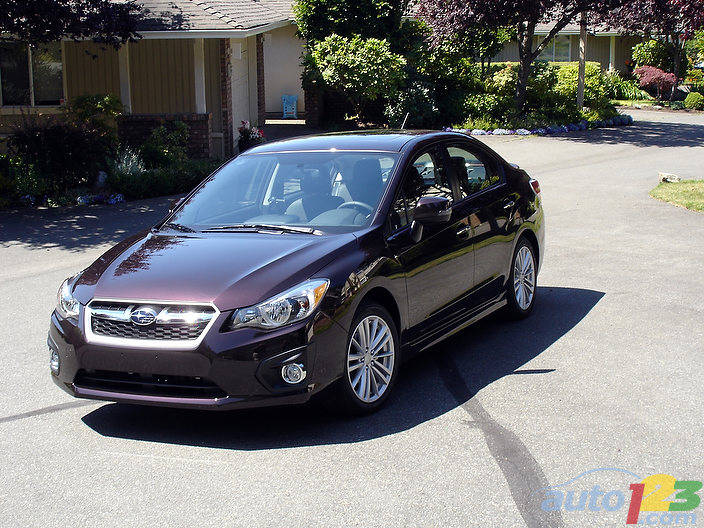
| Photo: Charles Renny/Auto123.com |
Suspension
The devil is in the details and Subaru has done a great job of exorcism. Suspension components consist of a MacPherson strut front suspension with a lower L-arm and double-wishbone rear, but then the changes start.
Up front, rebound springs have been added and the geometry has been revised. Sway bar bushings and their clamps have been re-engineered to make the sway bar more effective. In the rear, a new cradle with new bushings holds the double wishbones in place with more vigor and resulting improvements in handling.
Power steering has been replaced with an electronic unit that provides equally good road feel to the previous unit, weighs less and uses less horsepower.
Fuel Economy
Over the 2011 Impreza, body aerodynamics account for 8% while the electric power-steering system and weight reduction (50 kg) account for a 4% improvement in fuel economy. Subaru didn’t stop there, though. Engine design added another 8% and the new CVT puts in 10% by itself.
That means total fuel economy improvements over the previous generation come to 30%. According to Transport Canada, the new Impreza is rated at 7.5 L/100km in the city, 5.5 L/100km on the highway and a rating of 6.6 L/100km in the combined test.
At present, the Canadian introduction has been delayed to late October.
Article Gallery