





As we departed for the drive, I asked for a 4-cylinder SE model and I wasn't disappointed. While it can't be considered a no-holds-barred sport sedan, it felt great on the highway and down the country roads leading to the Shannonville speedway where we had the opportunity to pit the new Camry against multiple versions of the Ford Fusion and the Hyundai Sonata.
On our way there, both I and fellow Auto123.com writer Charles Renny noticed that the passenger seat is mounted a little too high and can't be lowered.
All Camrys get a faster steering ratio, which is probably the most welcome improvement, and cures the car from its previously lifeless handling feel. As before, the SE benefits from a sport-tuned suspension, providing a more controlled ride than in the LE and XLE versions.
On the track, the Camry quickly demonstrated its new savoir faire, circling around with as much composure as the Fusion and more than the Sonata. I never thought I'd someday be commenting on how well a Camry performed around a closed circuit. I wish the SE would offer better seat bolstering for less slippage when powering through turns, but it might be overkill in a Camry.
Both engines available are the same as in last year's model including a 2.5-litre inline-4 (178 hp, 170 lb.-ft) and a 3.5-litre V6 (268 hp, 247 lb.-ft). Both are mated to a 6-speed automatic with manual mode. But get this: The SE models now feature paddle shifters and – believe it or not – throttle blipping.
Fuel economy is also improved. The 4-cylinder engine is now rated at 8.2L/100km in the city and 5.6L/100km on the highway, while the V6 figures are 9.7 and 6.4 city/highway; those are class-leading numbers and we're not talking about the Hybrid (which we'll be covering in a separate article) that boasts fuel consumption ratings as low as 4.5/4.9 L/100km city/highway.
On our way there, both I and fellow Auto123.com writer Charles Renny noticed that the passenger seat is mounted a little too high and can't be lowered.
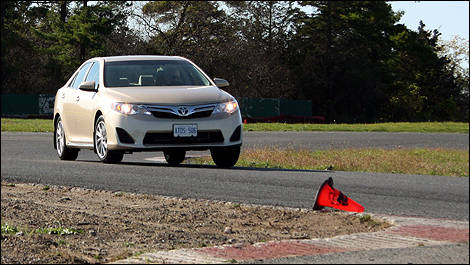 |
| As before, the SE benefits from a sport-tuned suspension, providing a more controlled ride as in the LE and XLE versions. (Photo: Michel Deslauriers/Auto123.com) |
All Camrys get a faster steering ratio, which is probably the most welcome improvement, and cures the car from its previously lifeless handling feel. As before, the SE benefits from a sport-tuned suspension, providing a more controlled ride than in the LE and XLE versions.
On the track, the Camry quickly demonstrated its new savoir faire, circling around with as much composure as the Fusion and more than the Sonata. I never thought I'd someday be commenting on how well a Camry performed around a closed circuit. I wish the SE would offer better seat bolstering for less slippage when powering through turns, but it might be overkill in a Camry.
Both engines available are the same as in last year's model including a 2.5-litre inline-4 (178 hp, 170 lb.-ft) and a 3.5-litre V6 (268 hp, 247 lb.-ft). Both are mated to a 6-speed automatic with manual mode. But get this: The SE models now feature paddle shifters and – believe it or not – throttle blipping.
Fuel economy is also improved. The 4-cylinder engine is now rated at 8.2L/100km in the city and 5.6L/100km on the highway, while the V6 figures are 9.7 and 6.4 city/highway; those are class-leading numbers and we're not talking about the Hybrid (which we'll be covering in a separate article) that boasts fuel consumption ratings as low as 4.5/4.9 L/100km city/highway.
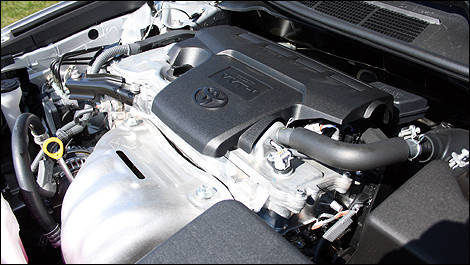 |
| Both engines available are the same as in last year’s model, including a 2.5-litre inline-4 (178 hp, 170 lb.-ft) and a 3.5-litre V6 (268 hp, 247 lb.-ft). (Photo: Michel Deslauriers/Auto123.com) |