





New ways of going green
Here's an interesting point: Research cited by Audi has indicated that driving behaviour can influence fuel consumption by up to 30%. In a nutshell, you can have the most fuel efficient vehicle on the market, but if the driver has one foot to the floorboards at all times, consumption figures likely won't be that impressive.
Many years ago, the Volkswagen Rabbit featured an upshift indicator in the instrument panel. This arrow symbol lit up when it was recommended that the driver shift into a higher gear to save fuel. The feature was wildly unpopular and it disappeared a few years late. Now it's back - and it's joined by some even more intrusive "driver aids".
Another A5 test car was fitted with all manner of efficiency-minded information for the instrument panel. By scrolling through the information, the driver could, for example, plan a trip along the Autobahn at a certain speed, then learn how much time he could save by driving 10 km/h faster or fuel he could save by driving 10 km/h slower.
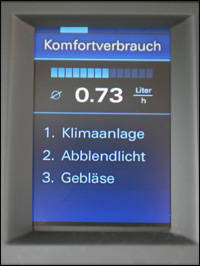
This car also featured something called the "Eco Trainer"; on-board tips on how to save fuel by, for example, closing the windows or turning down the air conditioner. The shift-indicator feature was part of this system; it showed the proper gear to generate maximum fuel efficiency in a bright image in the centre of the instrument panel.
At the end of a car trip, the Eco Trainer also provides a report for the driver on what they could do to save fuel on future trips, such as brake more gently and downshift only at low engine speeds.
While this system would likely generate results, it had two drawbacks. First, there was so much information to scroll through and view, it distracted from the task at hand - namely, driving. (Down the road, the Audi technician seated next to me suggested, these "driver hints" could be transmitted through vibrations in the steering wheel or pedals.)
Secondly, the system sucked all the fun out of driving the car by directing the driver to keep the car below about 2500 rpm at all times. This solution would seem to be extremely preachy; it's highly debatable whether any driver would welcome this kind of "coaching" at such regular intervals.
Here's an interesting point: Research cited by Audi has indicated that driving behaviour can influence fuel consumption by up to 30%. In a nutshell, you can have the most fuel efficient vehicle on the market, but if the driver has one foot to the floorboards at all times, consumption figures likely won't be that impressive.
Many years ago, the Volkswagen Rabbit featured an upshift indicator in the instrument panel. This arrow symbol lit up when it was recommended that the driver shift into a higher gear to save fuel. The feature was wildly unpopular and it disappeared a few years late. Now it's back - and it's joined by some even more intrusive "driver aids".
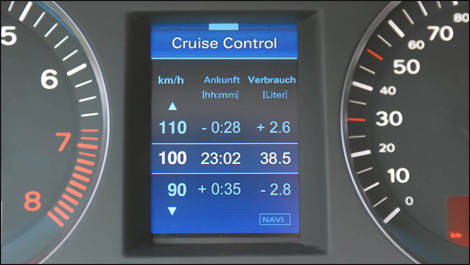 |
Another A5 test car was fitted with all manner of efficiency-minded information for the instrument panel. By scrolling through the information, the driver could, for example, plan a trip along the Autobahn at a certain speed, then learn how much time he could save by driving 10 km/h faster or fuel he could save by driving 10 km/h slower.
This car also featured something called the "Eco Trainer"; on-board tips on how to save fuel by, for example, closing the windows or turning down the air conditioner. The shift-indicator feature was part of this system; it showed the proper gear to generate maximum fuel efficiency in a bright image in the centre of the instrument panel.
 |
While this system would likely generate results, it had two drawbacks. First, there was so much information to scroll through and view, it distracted from the task at hand - namely, driving. (Down the road, the Audi technician seated next to me suggested, these "driver hints" could be transmitted through vibrations in the steering wheel or pedals.)
Secondly, the system sucked all the fun out of driving the car by directing the driver to keep the car below about 2500 rpm at all times. This solution would seem to be extremely preachy; it's highly debatable whether any driver would welcome this kind of "coaching" at such regular intervals.