





As a sign of China's presence within the world automotive scene, Beijing is
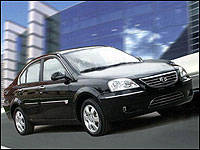 |
| Harbin Hafei Automobile Company used Auto China 2004 to introduce its first sedan, the Saibao. Interestingly the design comes from Pininfarina, following in the footsteps of Hafei's earlier Zhongyi minivan and Lobo minicar. It features Mitsubishi 1.6- and 2.0-liter engines, allowing it to pass EUR 3 regulations. Having passed European crash tests it is expected to be sold there in 2006. (Photo: Harbin Hafei Automobile Company) |
The inaugural Auto China show took place in 1990, but most of the majors weren't there. In less than 15 years China's economy has grown tremendously, with the last 24 months being the most significant for foreign investment into the country's burgeoning automotive industry. Now it's the must-have market, the place to be.
"This is their coming-out party," commented Michael Robinet, vice president
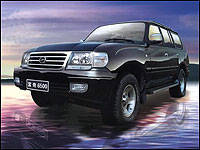 |
| Hebei Zhongxing Automobile Co., Ltd introduced an updated version of its Toyota Land Cruiser clone, the Fuqi 6500 at the Auto China 2004 exhibition. This is an ideal example of China's unwillingness to enforce global agreements with regards to blatantly "knocking off" other brand's identities. This "Toyota Land Cruiser" uses Mitsubishi power. (Photo: Hebei Zhongxing Automobile Co., Ltd) |
All the world's major automakers were there, showing made-in-China reproductions of popular nameplates as well as specific new cars designed for the new market. What made the Beijing show so unique, however, was the record number of domestic manufacturers that took part. A total of 1,600 carmakers were on hand, mostly obscure producers out to earn their piece of the extremely lucrative pie. Who would have thought the entrepreneurial spirit would be brightest in a communist nation? How times have changed.