





But even the very best tire (the school uses only Blizzaks) is governed by physics: the distribution of the car’s weight (or weight transfer) affects whether grip is distributed evenly among all four contact patches.
Accelerating lightens the vehicle’s front end and sends the weight, and most of the grip, to the rear.
A gentle application of brake redistributes the weight, and the grip more evenly. Too much brake – and all the weight is transferred to the front and rear grip is lost.
It’s important to “separate your controls” Croteau explains. Brake while the wheels are straight, keeping the foot off the pedal while steering around the corner, then apply the gas once the turn is completed. Tires are only designed to steer, accelerate, and stop. Asking too much of one thing comes at the expense of the others. “When in doubt, both feet out” says Croteau, emphasizing that if you’re not sure what to do in event of a skid, don’t use the gas or the brakes.
We also learn about the two types of skids: understeer (when the vehicle plows straight ahead, despite the wheel being cranked) and oversteer (when the back of the vehicle swings out.) Or, in the immortal words of the late, great Dale Earnhardt: “Oversteer is when your ass hits the wall, understeer is when your face hits it”.
Unlike many winter car control schools – Bridgestone’s exercises aren’t conducted in a simple parking lot with a course defined by cones.
The purpose-built racetrack features steep inclines, hairpins, several off-camber blind turns and incorporates an icy skid pad that’s built on a slope.
Over 250,000 gallons of water went into creating its slick surface – which is cushioned only by a slight dusting of powdery snow.
Drivers pair up with a partner, and the instructors communicate by way of a two-way radio in each car.
After several braking exercises, where we experience the difference between ABS (which, computer-aided, pumps the brake for you) and cadence braking (pumping the brake then releasing) we head to the circular skid pad to learn about skid control.
Accelerating lightens the vehicle’s front end and sends the weight, and most of the grip, to the rear.
A gentle application of brake redistributes the weight, and the grip more evenly. Too much brake – and all the weight is transferred to the front and rear grip is lost.
 |
| Lea Croteau outlining an upcoming exercise. (Photo: Lesley Wimbush/Auto123.com) |
It’s important to “separate your controls” Croteau explains. Brake while the wheels are straight, keeping the foot off the pedal while steering around the corner, then apply the gas once the turn is completed. Tires are only designed to steer, accelerate, and stop. Asking too much of one thing comes at the expense of the others. “When in doubt, both feet out” says Croteau, emphasizing that if you’re not sure what to do in event of a skid, don’t use the gas or the brakes.
We also learn about the two types of skids: understeer (when the vehicle plows straight ahead, despite the wheel being cranked) and oversteer (when the back of the vehicle swings out.) Or, in the immortal words of the late, great Dale Earnhardt: “Oversteer is when your ass hits the wall, understeer is when your face hits it”.
Unlike many winter car control schools – Bridgestone’s exercises aren’t conducted in a simple parking lot with a course defined by cones.
The purpose-built racetrack features steep inclines, hairpins, several off-camber blind turns and incorporates an icy skid pad that’s built on a slope.
Over 250,000 gallons of water went into creating its slick surface – which is cushioned only by a slight dusting of powdery snow.
Drivers pair up with a partner, and the instructors communicate by way of a two-way radio in each car.
After several braking exercises, where we experience the difference between ABS (which, computer-aided, pumps the brake for you) and cadence braking (pumping the brake then releasing) we head to the circular skid pad to learn about skid control.
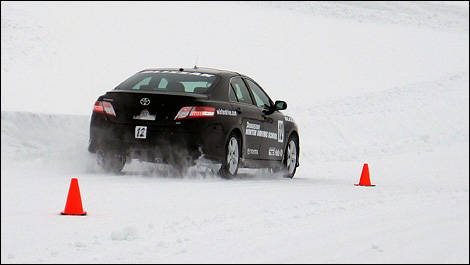 |
| A student practicing cadence braking. (Photo: Lesley Wimbush/Auto123.com) |