





The Oshawa-built Chevrolet Impala mid-size sedan has been a huge hit for General Motors in recent years against stiff Japanese competition, and there's widespread hope in the Canadian plant and in Detroit that the new and improved model going on sale late this summer will be considerably better.
GM hopes that a revised look, two new V-6s, extra upscale details, ''more confident'' handling, useful functionality like a flip-and-fold rear seat, and an optional V-8 with fuel-saving Displacement on Demand technology will help push the 2006 Impala up market a bit, into what the company calls the premium mid-car segment.
Impala is already a big hit in North America, but particularly the U.S., where sales success against such heavyweights as Honda Accord and Toyota Camry caused GM to add a third shift in Oshawa to meet demand.
According to Brent Dewar, the Canadian who was Chevrolet general manager before becoming the vice-president of marketing for GM's North American division, the 2006 Impala delivers ''more of what customers want from a large sedan -- uncompromising roominess, but with the performance and styling of a sports car.''
Impala's improved status is supposed to be obvious in its exterior style, which Dewar says is meant to ''convey sophistication and exude big-car roominess.'' Dewar is touching a hot button there with the roominess issue, since Impala is maybe the most expansive sedan in the segment, and that will make it appealing to lots of North Americans who appreciate more space.
More space for luggage, parcels and general stuff has also been created by the addition of the flip-fold rear seat and a pass-through to the trunk, which delivers most of the pragmatism of a hatchback without it actually be a hatch, which Americans think is too downscale for them. This sets Impala apart in this segment.
Impala's seat ''have a cleaner, simpler and more tailored appearance,'' says Dewar. ''Up-level, Nuance leather-covered seating features premium deck seams around their perimeter and French seams on the center cushions. The seats also have firmer cushions and increased lumbar support that provide more comfort, especially during long drives.''
Impala's all-new instrument panel wraps around into the door panels and has a ''double-hump design that is reminiscent of early Corvettes,'' says Dewar. ''All models except the Impala SS offer a wood-trimmed appearance or a sportier, brushed sterling-appearance trim. The Impala SS comes standard with a technical-pattern trim panel.''
The big technical news involves the newer V-6s and the addition of the 5.3-litre V-8.
''A new family of high-tech V-6s features cam phasing to optimize performance and economy,'' Dewar explains. The base model gets a new 3.5-litre V-6 that produces 211 hp and 214 lb-ft of torque, and there's an optional 3.9-litre V-6 rated at 240 horsepower and 245 lb-ft of torque, 90 percent of which is available from 1,800 to 5,800 rpm.
But the engine that most excites the people at Chevrolet is the 5.3-litre V-8 with Displacement On Demand in the Impala SS model. When power is required, the engine responds with 303 hp and 323 lb-ft of torque. In certain light-load situations, such as cruising at a steady speed, the engine shuts down half of its cylinders and uses less fuel as a result.
This technology improves fuel economy substantially (Chevrolet talks about something up to 12 percent) and does not affect the Impala's performance because it instantly returns the other four cylinders to duty when the situation or the driver demands.
GM hopes that a revised look, two new V-6s, extra upscale details, ''more confident'' handling, useful functionality like a flip-and-fold rear seat, and an optional V-8 with fuel-saving Displacement on Demand technology will help push the 2006 Impala up market a bit, into what the company calls the premium mid-car segment.
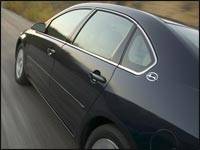 |
| 2006 Chevrolet Impala (photo: General Motors) |
According to Brent Dewar, the Canadian who was Chevrolet general manager before becoming the vice-president of marketing for GM's North American division, the 2006 Impala delivers ''more of what customers want from a large sedan -- uncompromising roominess, but with the performance and styling of a sports car.''
Impala's improved status is supposed to be obvious in its exterior style, which Dewar says is meant to ''convey sophistication and exude big-car roominess.'' Dewar is touching a hot button there with the roominess issue, since Impala is maybe the most expansive sedan in the segment, and that will make it appealing to lots of North Americans who appreciate more space.
More space for luggage, parcels and general stuff has also been created by the addition of the flip-fold rear seat and a pass-through to the trunk, which delivers most of the pragmatism of a hatchback without it actually be a hatch, which Americans think is too downscale for them. This sets Impala apart in this segment.
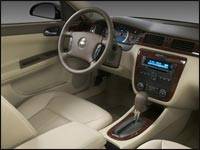 |
| 2006 Chevrolet Impala (photo: General Motors) |
Impala's all-new instrument panel wraps around into the door panels and has a ''double-hump design that is reminiscent of early Corvettes,'' says Dewar. ''All models except the Impala SS offer a wood-trimmed appearance or a sportier, brushed sterling-appearance trim. The Impala SS comes standard with a technical-pattern trim panel.''
The big technical news involves the newer V-6s and the addition of the 5.3-litre V-8.
''A new family of high-tech V-6s features cam phasing to optimize performance and economy,'' Dewar explains. The base model gets a new 3.5-litre V-6 that produces 211 hp and 214 lb-ft of torque, and there's an optional 3.9-litre V-6 rated at 240 horsepower and 245 lb-ft of torque, 90 percent of which is available from 1,800 to 5,800 rpm.
But the engine that most excites the people at Chevrolet is the 5.3-litre V-8 with Displacement On Demand in the Impala SS model. When power is required, the engine responds with 303 hp and 323 lb-ft of torque. In certain light-load situations, such as cruising at a steady speed, the engine shuts down half of its cylinders and uses less fuel as a result.
This technology improves fuel economy substantially (Chevrolet talks about something up to 12 percent) and does not affect the Impala's performance because it instantly returns the other four cylinders to duty when the situation or the driver demands.