





Look far ahead and anticipate any changes in traffic flow. This reduces the need to brake quickly. Resist the urge to slam on your brakes - use force when applying ABS brakes, then let off when you feel the wheels regain traction. The electronically controlled system applies on-off braking faster than we possibly could, those fractions of a second when the brakes are released allow the wheels to roll and regain grip. It's rare to encounter a vehicle without ABS these days, but the reflex reaction of slamming on the brakes is the worst thing we can do in a non-ABS car. The tires reach the limit of their grip, and the vehicle can slide, with deadly consequences. Instead, using a "cadence" method of pumping hard, then off, the tires can roll and regain some of that lost traction and stop the vehicle safely.
As good as winter tires are, no tires are designed for multi-tasking.
Don't brake while turning - you'll only cause the tires to lose their grip and provoke a slide. This is known as "understeer" (where the wheels are turned yet the vehicle plows in a straight line). Unwinding the wheel gently allows the wheels to regain grip, thus restoring steering ability.
Oversteer happens when the rear wheels lose their grip and the back of the vehicle starts to slide around. The immediate panic response in this situation is to slam on the brakes, but this is exactly the wrong response as it only causes the rear end to pivot harder around the front wheels. Instead, "countersteering" - gentle steering to the right (or "steering into the skid") and a careful application of the throttle brings it back under control.
Don't forget your sunglasses. During the dreary winter months, a good set of polarized lenses will help cut the snow's glare and reduce eye fatigue. Not only that - after the plow's blade has created a broad level swath - they'll help you distinguish between the road surface and the softer shoulder underneath.
Winter driving doesn't necessarily have to be a white-knuckle experience. With the proper tires and a little common sense... it can even be fun!
As good as winter tires are, no tires are designed for multi-tasking.
Don't brake while turning - you'll only cause the tires to lose their grip and provoke a slide. This is known as "understeer" (where the wheels are turned yet the vehicle plows in a straight line). Unwinding the wheel gently allows the wheels to regain grip, thus restoring steering ability.
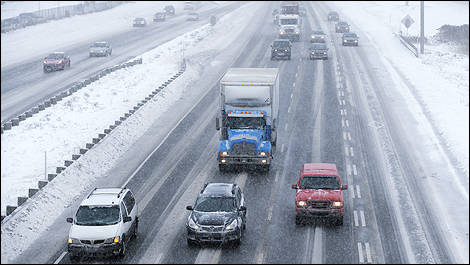 |
| Photo: Matthieu Lambert/Auto123.com |
Oversteer happens when the rear wheels lose their grip and the back of the vehicle starts to slide around. The immediate panic response in this situation is to slam on the brakes, but this is exactly the wrong response as it only causes the rear end to pivot harder around the front wheels. Instead, "countersteering" - gentle steering to the right (or "steering into the skid") and a careful application of the throttle brings it back under control.
Don't forget your sunglasses. During the dreary winter months, a good set of polarized lenses will help cut the snow's glare and reduce eye fatigue. Not only that - after the plow's blade has created a broad level swath - they'll help you distinguish between the road surface and the softer shoulder underneath.
Winter driving doesn't necessarily have to be a white-knuckle experience. With the proper tires and a little common sense... it can even be fun!