





Adapted from Lotus Renault GP
Jarrod Murphy, head of the Computational Fluid Dynamics of Lotus Renault, guides us into his department within the Enstone's factory.
Tucked away in the lush green Oxfordshire countryside, at Enstone, Jarrod Murphy’s tall frame leads us through a set of large doors, down a long corridor and into the heart of the Lotus Renault GP.
The Computational Fluid Dynamics (CFD) department is housed in what is essentially a series of large rooms in a bunker-like building built into a hill behind the main Enstone factory. Like everywhere else at Enstone, the place is spotless, but here especially, as the facility is so new the floors shine.
"We have one of the strongest CFD facilities in F1," states Jarrod Murphy proudly, punching in a security access code and showing the ‘cluster’ - huge banks of computers running millions of computational simulations simultaneously, and noisily, it has to be said.
"That’s the noise of the fans because the cluster is running 24/7 evaluating many different ideas, and concepts. Usually new ideas start off in CFD before putting them into the wind tunnel to get some tunnel data. We’re getting data constantly. It’s the rate at which we find them that’s crucial. All of the teams are improving their cars all the time, no team is standing still, so our job is to find them at a quicker rate than the other teams," explains Jarrod Murphy, who has been with the team since 1996.
CFD chief admits his team is motivated to do better, and be better, than other teams. To see the car move up the grid by developing it more quickly and, he stresses, faster than the other teams are developing their cars. This success lies in managing the working process efficiently.
"The more efficient we are, the more ideas we can get through the cluster. This increases our hit-rate which translates directly to better performance on the track. Engineers like solving problems and the problem is trying to generate more downforce within the rules that you’re given. The ultimate gauge of our department’s performance is the amount of downforce we put on the car, so it’s a clear indicator of how good a job we’re doing," says Jarrod Murphy.
Jarrod Murphy, head of the Computational Fluid Dynamics of Lotus Renault, guides us into his department within the Enstone's factory.
Tucked away in the lush green Oxfordshire countryside, at Enstone, Jarrod Murphy’s tall frame leads us through a set of large doors, down a long corridor and into the heart of the Lotus Renault GP.
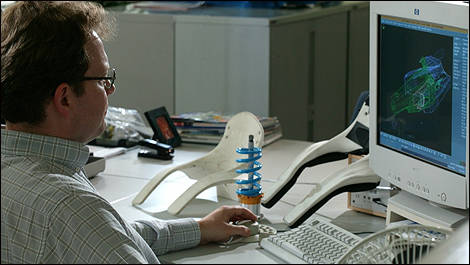 |
| Work station of the Renault CFD department. (Photo: Lotus Renault GP) |
The Computational Fluid Dynamics (CFD) department is housed in what is essentially a series of large rooms in a bunker-like building built into a hill behind the main Enstone factory. Like everywhere else at Enstone, the place is spotless, but here especially, as the facility is so new the floors shine.
"We have one of the strongest CFD facilities in F1," states Jarrod Murphy proudly, punching in a security access code and showing the ‘cluster’ - huge banks of computers running millions of computational simulations simultaneously, and noisily, it has to be said.
"That’s the noise of the fans because the cluster is running 24/7 evaluating many different ideas, and concepts. Usually new ideas start off in CFD before putting them into the wind tunnel to get some tunnel data. We’re getting data constantly. It’s the rate at which we find them that’s crucial. All of the teams are improving their cars all the time, no team is standing still, so our job is to find them at a quicker rate than the other teams," explains Jarrod Murphy, who has been with the team since 1996.
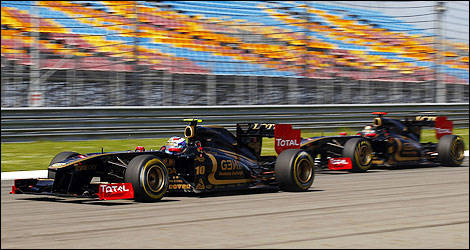 |
| Photo: Lotus Renault GP |
CFD chief admits his team is motivated to do better, and be better, than other teams. To see the car move up the grid by developing it more quickly and, he stresses, faster than the other teams are developing their cars. This success lies in managing the working process efficiently.
"The more efficient we are, the more ideas we can get through the cluster. This increases our hit-rate which translates directly to better performance on the track. Engineers like solving problems and the problem is trying to generate more downforce within the rules that you’re given. The ultimate gauge of our department’s performance is the amount of downforce we put on the car, so it’s a clear indicator of how good a job we’re doing," says Jarrod Murphy.