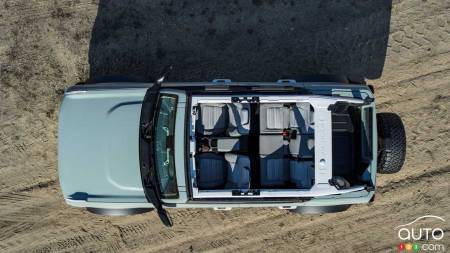
• New patents filed by Ford for sliding roof designs for its Bronco show the company keeps looking for ways to make open-air driving easier to get to.
Open-air driving is the must-have for any true off-road enthusiast. Ford has gone straight after the Jeep Wrangler crowd with its Bronco, and as such spends a lot of time thinking about how to make it easier for users to get to an open-air state with their vehicle.
That’s a work in progress. When it comes to stripping their Bronco of doors and roofs, owners know the routine: removing the bulky hard-top panels is often a cumbersome, time-consuming chore that requires lining up finicky weather seals and sacrificing precious cargo space to store the removed parts. Leaving panels at home creates a favourable environment for disaster if an unexpected rainstorm rolls in.
Now, the Blue Oval brand appears to have come up with some ideas that could simplify the process. Two, in fact. The United States Patent and Trademark Office (USPTO) recently published two new Ford patent applications that could deliver a flexible, open-top experience without requiring owners to dismantle a single component. Originally spotted by Ford Authority, the dual designs suggest that Ford is looking for added momentum as it continues to go after Jeep with its Wrangler.
The two systems function as self-contained units that eliminate the need to devote storage space to roof parts inside the vehicle.
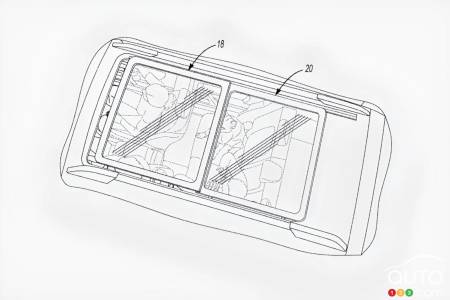
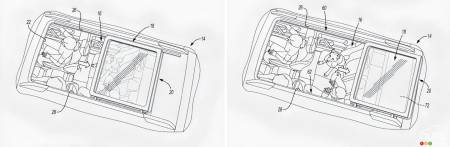
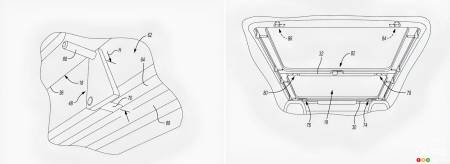
The first patent features two transparent, see-through panels that operate like a multi-stage panoramic moonroof. Riding on a series of guide tracks, the foremost panel can slide over the rear panel, and both can slide together over the rear cargo area.
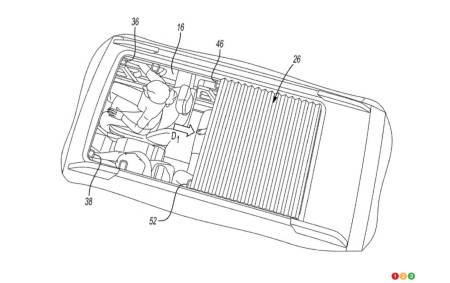
The second patent details an accordion-style fabric roof. Because fabric tends to sag or bunch, this variant relies on a track-and-hoop design where transverse support rods keep the material taut when closed, folding into vertical folds like an accordion when unlatched and slid rearward.
Manually operated systems
Neither design relies on an electric motor. Instead, Ford engineers envisioned a manual setup using a slide handle deployed from within the cabin. While a push-button motorized system like Jeep’s Sky One-Touch Power Top offers effortless operation, Ford’s manual approach avoids mechanical complexity and ensures fewer components are at risk of failing.
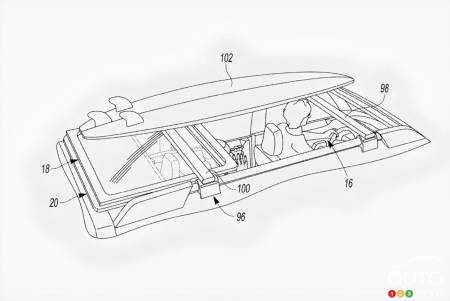
Beyond user convenience, the real genius of these designs lies in their compatibility with lifestyle accessories. In the current 2026 Bronco, owners must completely detach the roof rack before removing the factory roof panels. The new patent illustrations demonstrate that the guide tracks are recessed beneath the clearance zone of the roof rails. This allows drivers to slide the panels fully open even with a surfboard or bike strapped to the roof.
The patents are for the roof only, meaning removing the doors will still require a ratchet and socket from the vehicle's toolkit.
It’s also worth noting that these designs are merely concepts for now. Automakers frequently file patents to protect intellectual property and prevent competitors from using similar ideas. Whether Ford gives these sliding panels the production green light remains to be seen, but the innovation shows a clear commitment to making the Bronco's open-air freedom a breeze.