





This is my third and final report from the conference. If you’ve been following my previous stories, you’ll be fully conversant with what’s new at Ford, and the point at which automotive technology currently stands. However, I did promise you a glimpse into the future!
For quite some time now, Ford has been working with other car companies and in some cases, government departments, with the aim of predicting the future of road transportation. Naturally, we all have our own ideas. In fact, I’m old enough to recall when we were told that we’d all be flying cars by now. However, I’ve just experienced first-hand what the future may have in store for us, so let me explain.
It’s all about vehicle connectivity
Picture a world where every vehicle on the road communicated with each other, just like humans do. If I’m carrying a heavy load and you happen to be blocking my path, I might say, “Excuse me, but may I pass please?”
Now imagine that your car could do exactly the same thing. Technically, it is possible. After all, we have GPS systems in our vehicles, so they know where we are at any given moment, even if we don’t. Vehicles can also send and receive information now, and with modern WiFi communication, this has become even simpler.
However, imagine if all this technology was put together in such a way, that every vehicle on the road was in constant communication with all other vehicles in its vicinity. Then picture traffic lights communicating with your vehicle, or even highways which send out information directly into the vehicles traveling on them.
Well, glimpse the future my friends, because I’ve actually seen this in action!
At Ford’s Technology conference in Dearborn, Michigan, I was privileged to be a participant in three separate demonstrations of how this might one day be achieved.
Demo #1
Visualize... You’re traveling in a line of traffic at around 60 km/h, when suddenly the vehicle two cars ahead of you brakes without warning. What do you do? After all, you couldn’t see past the vehicle just ahead of you!
However, our test vehicle came equipped with some of the technology I’ve previously mentioned, and before we could see the brake lights deploy on the car in front of us, our vehicle had received a warning from the leading vehicle (via WiFi) that it was braking, and a warning buzzer sounded in our vehicle.
For quite some time now, Ford has been working with other car companies and in some cases, government departments, with the aim of predicting the future of road transportation. Naturally, we all have our own ideas. In fact, I’m old enough to recall when we were told that we’d all be flying cars by now. However, I’ve just experienced first-hand what the future may have in store for us, so let me explain.
It’s all about vehicle connectivity
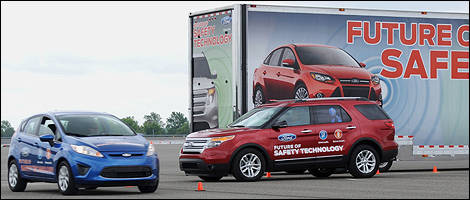
Picture a world where every vehicle on the road communicated with each other, just like humans do. If I’m carrying a heavy load and you happen to be blocking my path, I might say, “Excuse me, but may I pass please?”
 |
| Photo: Ford |
Now imagine that your car could do exactly the same thing. Technically, it is possible. After all, we have GPS systems in our vehicles, so they know where we are at any given moment, even if we don’t. Vehicles can also send and receive information now, and with modern WiFi communication, this has become even simpler.
However, imagine if all this technology was put together in such a way, that every vehicle on the road was in constant communication with all other vehicles in its vicinity. Then picture traffic lights communicating with your vehicle, or even highways which send out information directly into the vehicles traveling on them.
Well, glimpse the future my friends, because I’ve actually seen this in action!
At Ford’s Technology conference in Dearborn, Michigan, I was privileged to be a participant in three separate demonstrations of how this might one day be achieved.
Demo #1
Visualize... You’re traveling in a line of traffic at around 60 km/h, when suddenly the vehicle two cars ahead of you brakes without warning. What do you do? After all, you couldn’t see past the vehicle just ahead of you!
However, our test vehicle came equipped with some of the technology I’ve previously mentioned, and before we could see the brake lights deploy on the car in front of us, our vehicle had received a warning from the leading vehicle (via WiFi) that it was braking, and a warning buzzer sounded in our vehicle.