





The engine, developed at the Beech Daly Technical Center in Dearborn, Michigan, a state of the art facility with some of the most
advanced prototype development hardware the auto industry has to offer, some of which does not exist at any rival auto manufacturer's facility, is set to be produced at the Lima Engine Plant, in Ohio (not Peru). As expected, it's an extremely sophisticated piece of engineering that will quickly elevate Ford's street cred among V6 buyers.
A number of high-tech goodies make the new 3.5-liter V6 stand out in its class, such as cracked-powder metal connecting rods, a composite split plenum intake manifold, an electronic throttle body, high temperature cast aluminum pistons with low-friction coated skirts and low-tension rings, shimless bucket tappets, centrally located spark plugs, and more.
What will matter more to those less technically adept will be its low expected fuel consumption, PZEV capable emissions rating and hybrid adaptability. Ford wouldn't make a new engine that wasn't hybrid ready, being that it is the undisputed domestic leader in HEVs (although GM looks ready and willing to take over that spot), so expect more and more alternative powertrain vehicles featuring the automaker's third generation hybrid
transaxle to fill up the its three-brand lineup - 250,000 per year to be sold by 2010.
"The 3.5-liter V6 is capable of achieving PZEV certification by delivering low cold-start emissions and enabling rapid catalyst light-off, which is a significant accomplishment for a larger displacement V6 engine," stated Tom McCarthy, engine systems manager for the 3.5-liter V6 engine program.
Ford confidently claims its high compression 3.5 is extremely smooth-running thanks to a low vibration valve-train, for one, plus reduced powertrain bending, a high-tech term for engine block stiffness, the result of a high pressure die casting method. It reportedly delivers great off-the-line acceleration and more than enough power during passing maneuvers. Fuel economy and emissions concerns have been addressed also, with special attention paid to reducing toxins during cold startup.
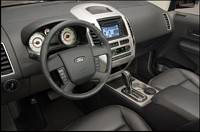 |
| The Edge's interior is extremely stylish, and if built to the same level as Ford's new Fusion should also be superbly crafted. (Photo: Ford Motor Company of Canada) |
A number of high-tech goodies make the new 3.5-liter V6 stand out in its class, such as cracked-powder metal connecting rods, a composite split plenum intake manifold, an electronic throttle body, high temperature cast aluminum pistons with low-friction coated skirts and low-tension rings, shimless bucket tappets, centrally located spark plugs, and more.
What will matter more to those less technically adept will be its low expected fuel consumption, PZEV capable emissions rating and hybrid adaptability. Ford wouldn't make a new engine that wasn't hybrid ready, being that it is the undisputed domestic leader in HEVs (although GM looks ready and willing to take over that spot), so expect more and more alternative powertrain vehicles featuring the automaker's third generation hybrid
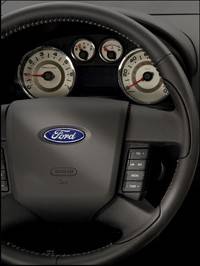 |
| More power and Ford's efficient new six-speed transmission should make the most of the white-faced speedometer. (Photo: Ford Motor Company of Canada) |
"The 3.5-liter V6 is capable of achieving PZEV certification by delivering low cold-start emissions and enabling rapid catalyst light-off, which is a significant accomplishment for a larger displacement V6 engine," stated Tom McCarthy, engine systems manager for the 3.5-liter V6 engine program.
Ford confidently claims its high compression 3.5 is extremely smooth-running thanks to a low vibration valve-train, for one, plus reduced powertrain bending, a high-tech term for engine block stiffness, the result of a high pressure die casting method. It reportedly delivers great off-the-line acceleration and more than enough power during passing maneuvers. Fuel economy and emissions concerns have been addressed also, with special attention paid to reducing toxins during cold startup.