





The aged wiring harness had to go, Welburn says, but it was remade "using new materials faithful to the original design."
Certain components -- such as the silver leather bucket seats -- were restored "without loss of the patina acquired during years of use." That's a nice way to describe the wear and tear created by famous fannies belonging to Mitchell and many others.
To his credit, Welburn felt "we should leave the seats basically alone. After all, Bill Mitchell and a lot of other famous people have driven the Sting Ray or at least sat in these buckets. So, instead, of totally reupholstering them, we decided to leave the patina intact for anyone who encounters the car to appreciate."
Hand-made brass trim plates and escutcheon badges were re-chrome plated, and the original Halibrand magnesium wheels were carefully polished to the proper luster.
Much of the internal paneling was hand-formed sheet aluminum, Welburn says, which has been straightened and rid of battle scars acquired on the race track. Scars, apparently, do not qualify as patina.
Numerous engines have resided under the Sting Ray Racer's hood, the most recent of which is a 5.7-liter small block V-8 equipped with an all-mechanical fuel injection system from the 1960s.
Hours of effort were devoted to repairing cracks in the original fiberglass body panels and replacing balsawood reinforcements that had deteriorated.
"Constructing an all new body would probably have been easier," Welburn says, "but GM Design personnel took the longer road to preserve original components and craftsmanship where possible. The paint applied to the fastidiously finished surfaces is a period-correct silver sparkle acrylic lacquer protected by a clear top coat."
Welburn actually signed on at GM in the Advanced Design Studios when Mitchell was still in charge, so he says it's a thrill for him to have been the driving force behind the restoration project.
"It's not that often that we have the luxury of a fond look back to what GM designers have accomplished," he says. "Our more pressing mission is looking ahead, aggressively advancing the process to create strong, bold designs that are highly contemporary. But, in order to do that, we need to understand our history. Not dwell on it, but to understand it and to appreciate it. So, as soon as we complete the Sting Ray Racer, we'll move on to the next jewel in GM's showcase that warrants attention."
photo:General Motors
Certain components -- such as the silver leather bucket seats -- were restored "without loss of the patina acquired during years of use." That's a nice way to describe the wear and tear created by famous fannies belonging to Mitchell and many others.
To his credit, Welburn felt "we should leave the seats basically alone. After all, Bill Mitchell and a lot of other famous people have driven the Sting Ray or at least sat in these buckets. So, instead, of totally reupholstering them, we decided to leave the patina intact for anyone who encounters the car to appreciate."
Hand-made brass trim plates and escutcheon badges were re-chrome plated, and the original Halibrand magnesium wheels were carefully polished to the proper luster.
Much of the internal paneling was hand-formed sheet aluminum, Welburn says, which has been straightened and rid of battle scars acquired on the race track. Scars, apparently, do not qualify as patina.
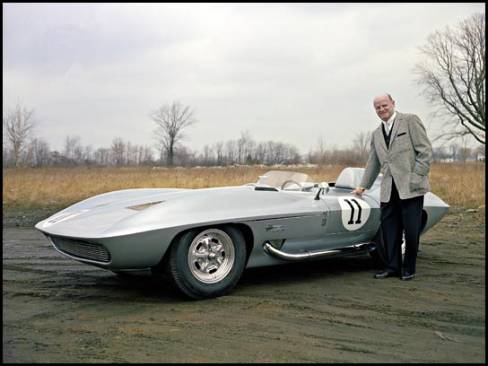
 |
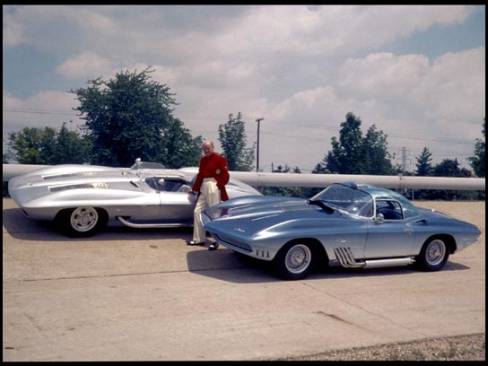
| Sting Ray Racer (photo: General Motors) |
Hours of effort were devoted to repairing cracks in the original fiberglass body panels and replacing balsawood reinforcements that had deteriorated.
"Constructing an all new body would probably have been easier," Welburn says, "but GM Design personnel took the longer road to preserve original components and craftsmanship where possible. The paint applied to the fastidiously finished surfaces is a period-correct silver sparkle acrylic lacquer protected by a clear top coat."
Welburn actually signed on at GM in the Advanced Design Studios when Mitchell was still in charge, so he says it's a thrill for him to have been the driving force behind the restoration project.
"It's not that often that we have the luxury of a fond look back to what GM designers have accomplished," he says. "Our more pressing mission is looking ahead, aggressively advancing the process to create strong, bold designs that are highly contemporary. But, in order to do that, we need to understand our history. Not dwell on it, but to understand it and to appreciate it. So, as soon as we complete the Sting Ray Racer, we'll move on to the next jewel in GM's showcase that warrants attention."
photo:General Motors
Article Gallery