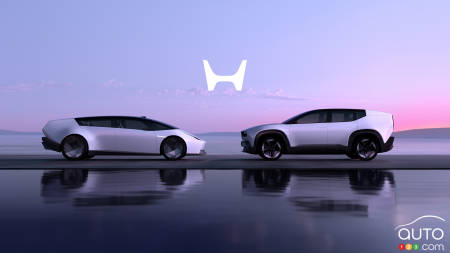
Honda is the latest automaker to undertake a significant shift away from all-electric models in North America. The Japanese auto giant announced today that it has cancelled three major electric vehicle programs slated for North American production.
It’s not hard to discern the Why of this decision. Cooling demand for EVs, the high cost of development coming just as companies like Honda are tightening their belts, and a U.S. administration openly hostile to BEVs add up to a move like Honda confirmed today.
The cancelled programs include the Honda 0 sedan and 0 SUV, and the Acura RSX. These models were intended to spearhead Honda’s next phase of regional manufacturing.

The move to cancel these models entails substantial costs, of course. Honda estimates the reset could result in expenses and losses totalling ¥2.5 trillion ($21.4 billion CAD) over several fiscal years.
The immediate impact is equally severe. For the fiscal year ending March 31, 2026, Honda has replaced its previous profit forecast with an expected net loss of up to ¥570 billion, or $4.9 billion CAD. That’s the company’s first annual loss since it went public in 1957.
To acknowledge the gravity of the situation, CEO Toshihiro Mibe and Executive VP Noriya Kaihara will take a 30-percent pay cut for three months, while other executives will see a 20-percent reduction.
Honda cites a number of reasons for the move, most important among them slower EV growth in the U.S. driven by shifting regulatory landscapes and the removal of EV incentives, global trade tariffs and weakening sales in the Chinese market.
In Canada, the news adds further uncertainty as the company’s previously stated goals clearly no longer apply. While Honda previously announced massive investments in Ontario for EV assembly and battery production, those projects remain on ice as the market adjusts.
Looking forward, Honda is doubling down on internal-combustion alternatives. Noriya Kaihara confirmed that the company is shifting focus toward a next-generation hybrid powertrain and an advanced automated driving system, both targeted for launch after 2027.
In North America, Honda intends to increase the local procurement of components to support the bolstered hybrid lineup, signalling that, for the remainder of the decade, the road to electrification will be paved with gas-electric transitions rather than pure battery power.