





Following a strategic retreat from its ambitious all-electric vehicle plans, Honda is preparing to double down on its most profitable market. CEO Toshihiro Mibe recently revealed that the Japanese automaker is planning to build an eighth vehicle assembly plant in North America. Why? For three very good reasons:
1) To boost market share in its most important market;
2) To circumvent potential tariffs that could obstruct its growth in that market;
3) U.S. consumer demand for hybrids and ICE vehicles has soared.
How important is North America to Honda? It accounts for somewhere around 40 percent of its global sales. The company currently has seven assembly plants on the continent, including four in the U.S., two in Canada (centered in Alliston, Ontario) and one in Mexico, and they are currently running at 90 percent of their annual 1.8-million-vehicle capacity.
“If you don't have a buffer, you can't recover production,” Mibe told Japan’s Yomiuri Shimbun newspaper, emphasizing the need for operational wiggle room as Honda targets a U.S. market share beyond its current 9 percent.
For Reason Number Two cited above, we can be fairly sure that by North American plant, Honda means a U.S. plant. But we shall see what the future holds.

Sharp shift in strategy
The potential manufacturing expansion follows a massive, multi-billion-dollar 0-shaped pivot. Shifting consumer sentiment and changes to federal tax incentives in the U.S. led Honda to scrap its entire upcoming 0 Series EV lineup. Just recently, the brand discontinued the GM-built Prologue electric SUV after sales plummeted up to 50 percent in the first half of the year.
Rather than chasing an electric market that is currently anemic in the U.S., Honda is redirecting its focus toward high-demand hybrid powertrains. Mibe noted that mainstream American buyers are unlikely to adopt EVs fully for at least another five years, making local hybrid production the smarter, more stable play for the short term.
Made in the USA
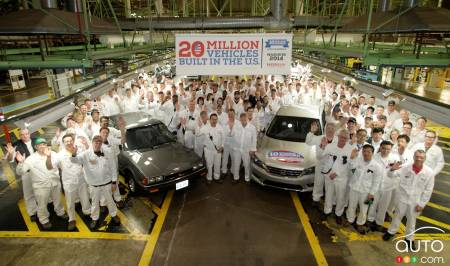
An eighth facility would further solidify Honda’s massive footprint as a domestic manufacturing powerhouse. The brand already builds 13 models that rank highly on the Cars.com American-Made Index, with its Alabama plant leading the industry in top-10 ranked vehicles.
By expanding local assembly, Honda intends to adhere to its core philosophy of building cars where they are sold, while safeguarding its supply chain against volatile import policies.
For now, Honda is maintaining that it has not made any definitive decisions regarding a new plant, including where and when it might set up, and even if it will. But it seems very likely to happen, since the automaker's leadership has made it clear that expanding capacity is the definitive next step.