





As the U.S. administration continues to threaten its Canadian and Mexican allies with 25-percent tariffs on imports, Honda is preparing several countermeasures. The Japanese automaker, which relies on its factories in those countries for around a third of its sales in the U.S., plans to ramp up production in February to create inventory before any tariffs take effect.
Honda Executive VP Shinji Aoyama says the tariffs could represent a cost of $185 million for the current fiscal year, which ends March 31, 2025.
Short- and medium-term strategy
Honda plans to ramp up production and manufacture more vehicles before the taxes take effect. Another option is to change the mix of models produced in Canada and Mexico, and in parallel, increase U.S. production to offset the impacted volumes.
“We will try to import these vehicles earlier into the U.S.,” said Aoyama. “In the medium term, we may change the allocation of models as needed.” The automaker did not specify which models might be affected by these adjustments.
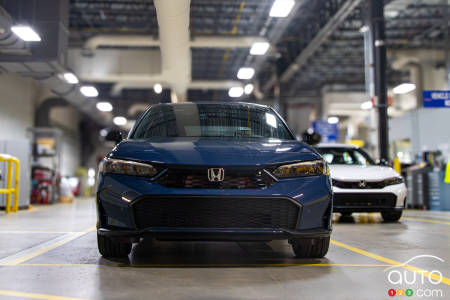
Which Honda models are affected?
The models most exposed to the tariffs are:
- - Honda Civic and Honda CR-V, made in Alliston, Ontario, but also produced in Ohio
- - Honda HR-V, assembled in Mexico, with U.S. sales up 24 percent in 2024 (151,468 units)
- - Acura ADX, to be imported from Mexico this year
In 2024, Honda exported just 5,379 vehicles from Japan to the U.S., out of 1.42 million sold in the US. A tax on imports from Canada and Mexico could have a major impact on its sales.
The Trump administration has postponed the application of tariffs until March 2025, leaving room for possible trade negotiations.

Honda's financial results up despite challenges
Despite these uncertainties, Honda increased its operating profit by 4.6 percent, reaching 397.3 billion yen (2.52 billion USD) in the third fiscal quarter (October-December 2024).
Key figures:
- ✔️ Revenues: 50.2 billion (+1.4 percent)
- ✔️ Worldwide sales: 1.04 million vehicles (-14 percent)
- ✔️ North America: 435,000 vehicles (-0.5 percent)
- ✔️ Europe: 17,000 units (-32 percent)
- ✔️ Asia (including China): 364,000 units (+7.1 percent)
Honda has, however, reduced its annual sales forecast, expecting 3.75 million units by March 2025, compared with 3.9 million originally forecast. Despite that reduction, Honda is maintaining its profitability target, thanks to improved cost management and greater pricing power.
Adapting to realities
Honda is rapidly adjusting its production to limit the potential impact of U.S. tariffs. The introduction of 25-percent duties in March could prompt the automaker to relocate more of its production to the U.S.
With sales down slightly, but profits up, Honda remains resilient in the face of market uncertainties. The next step will depend on the progress of trade negotiations between the U.S., Canada and Mexico.