


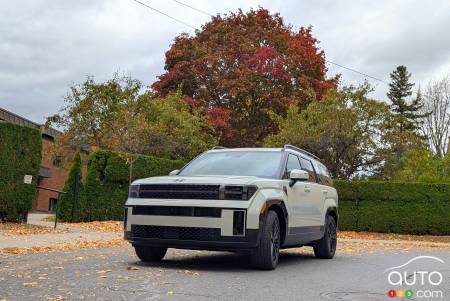



Hyundai Motor Group is taking a pragmatic leap in its electrification strategy. The Korean auto giant has confirmed plans to introduce extended-range electric vehicles (EREVs) to both the Hyundai and Genesis lineups by early 2027. Announced during the company’s CEO Investor Day in Seoul, the move aims to bridge the gap between traditional hybrids and full battery-electric vehicles while directly targeting range anxiety.
A Santa Fe EREV
Leading the charge for the Hyundai brand will be the midsize Santa Fe, coinciding with a mid-cycle refresh for its fifth generation. Scheduled for production at Hyundai’s assembly plant in Alabama, the Santa Fe EREV uses a dual-motor configuration to maintain all-wheel-drive capability. Rather than driving the wheels directly, the onboard gas engine functions purely as a generator to recharge an in-house developed battery pack, estimated between 35 and 45 kWh.

By combining plug-in charging with gas-powered energy generation, Hyundai targets a total driving range of up to 965 km, roughly 1.6 times the distance of a standard gasoline Santa Fe. While offering instantaneous torque and smooth acceleration identical to a pure EV, the EREV configuration allows for long-distance travel without worrying about recharging.
It’s worth keeping in minds that because the model is designated for U.S. manufacturing, availability in Canada remains subject to ongoing trade considerations and tariff dynamics.
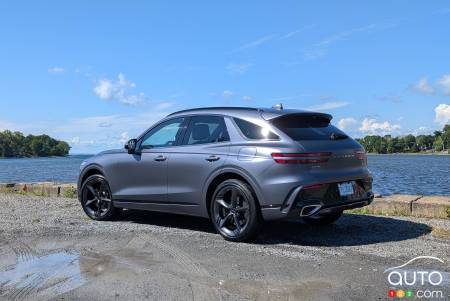
Genesis also on board
Luxury brand Genesis will adopt the new powertrain shortly thereafter, applying the tech to models like the GV70 crossover and potentially the larger GV80. The Genesis EREVs, set to be assembled in South Korea, promise high-performance battery setups capable of stretching overall range past the 1,000-km mark (640 miles). This arrives alongside a conventional 352-hp hybrid system slated for the GV80.
EREVs are gaining traction across the industry as a stepping stone toward full zero-emission targets, joining upcoming projects from competitors like Ram, Jeep and Ford. For Hyundai, adding range extenders reinforces an all-encompassing powertrain philosophy. By providing gasoline, traditional hybrid, plug-in hybrid, EREV and full electric options, the automaker is looking to cover every base.