





Developed in 1990, the four-cylinder "Alpha" was Hyundai's first proprietary engine.
"This was our liberation engine" he says, and goes on to explain with great relish that the company now sells its engine technology back to Mitsubishi.
More than 2,000 engineers work here to develop powertrains for both Hyundai and Kia vehicles; although Hyundai owns 34% of Kia and they share mechanical working parts, they are otherwise separate entities. The in-house engines now feature several four- and six-cylinders units, the Tau V8s and several diesels for both passenger car and commercial use. Hyundai now produces its own transmissions, including the new 6-speed DCT in the Veloster and soon-to-be-released CVT and 8-speed versions. Under development is a 10-speed automatic transmission.
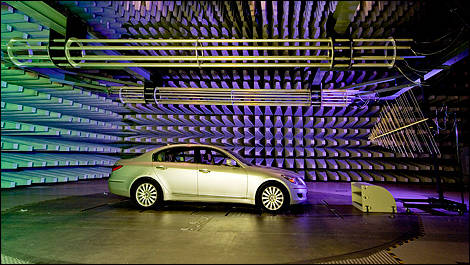
Inside the 100x60-metre, $45-million wind tunnel chamber, the spoken word falls flat thanks to walls lined with honeycomb-like anechoic tile. The sound-deadening effect is eery - and the chamber smells disturbingly urine-like. At either end are huge, gaping openings – one of which houses the enormous turbine producing winds of up to 200 km/h. We're rather surprised to learn that the turbine's blades are manufactured in Canada.
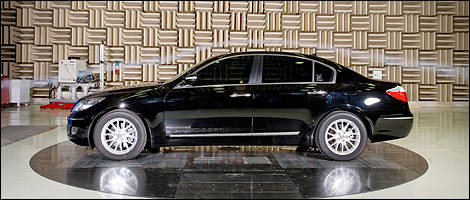
Unfortunately, we don't get a demonstration of the wind tunnel in action, but learn that the rotating steel plate at its centre acts as a giant scale – measuring changes in suspension compression and recording coefficient of drag and lift force.
On the platform, what is obviously a Veloster hides beneath a cloth, but we can see that its hindquarters have been reworked, presumably to affect more downforce. Underneath peep twin, round tailpipes instead of the current model's rectangular tips. We're certain that we're looking at the turbocharged Veloster, rumoured to be near production, but our questions just result in head shakes and enigmatic smiles.
"This was our liberation engine" he says, and goes on to explain with great relish that the company now sells its engine technology back to Mitsubishi.
 |
| Photo: Lesley Wimbush/Auto123.com |
More than 2,000 engineers work here to develop powertrains for both Hyundai and Kia vehicles; although Hyundai owns 34% of Kia and they share mechanical working parts, they are otherwise separate entities. The in-house engines now feature several four- and six-cylinders units, the Tau V8s and several diesels for both passenger car and commercial use. Hyundai now produces its own transmissions, including the new 6-speed DCT in the Veloster and soon-to-be-released CVT and 8-speed versions. Under development is a 10-speed automatic transmission.
Inside the 100x60-metre, $45-million wind tunnel chamber, the spoken word falls flat thanks to walls lined with honeycomb-like anechoic tile. The sound-deadening effect is eery - and the chamber smells disturbingly urine-like. At either end are huge, gaping openings – one of which houses the enormous turbine producing winds of up to 200 km/h. We're rather surprised to learn that the turbine's blades are manufactured in Canada.
Unfortunately, we don't get a demonstration of the wind tunnel in action, but learn that the rotating steel plate at its centre acts as a giant scale – measuring changes in suspension compression and recording coefficient of drag and lift force.
On the platform, what is obviously a Veloster hides beneath a cloth, but we can see that its hindquarters have been reworked, presumably to affect more downforce. Underneath peep twin, round tailpipes instead of the current model's rectangular tips. We're certain that we're looking at the turbocharged Veloster, rumoured to be near production, but our questions just result in head shakes and enigmatic smiles.
 |
| Photo: Lesley Wimbush/Auto123.com |