But problems exist at a deeper level. The Swedish-engineered Saabs (9-3 and 9-5) currently in production are dating rapidly. The 9-5, introduced
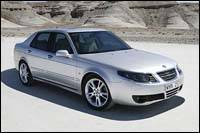 |
| The 9-5, introduced in face-lifted form at the Frankfurt auto show in September, is bordering a decade in age under the skin. (Photo: Saab Canada) |
in face-lifted form at the Frankfurt auto show in September, is bordering a decade in age under the skin, and the Epsilon-chassis based 9-3 is already starting to sag around its edges in light of newer, sharper competitors, even with its powerful new Holden (GM of Australia) twin-turbo V6. A replacement for the large Saab won't arrive for another few years, given GM's questionable decision to pay Italian partner Fiat off (or more correctly the poor deal that was struck with Fiat in the first place, that forced GM's hand). Fiat,
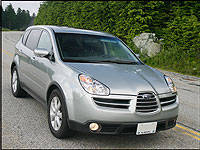 |
| Before Subaru was sold, Saab's plans included the development of a large crossover vehicle to be based off of the B9 Tribeca. (Photo: Trevor Hofmann, Canadian Auto Press) |
now some billions of dollars richer, also walked off with what has been claimed by several magazines to be the finest front-wheel drive platform in existence; a variable wheelbase, all-wheel drive capable platform which was supposed to be shared with Saab. Hmmm...
As of earlier this year, analysts had created a lovely flowchart which depicted Saab's return to its former glory days. It included the development of a large crossover vehicle called the 9-6X, which was to be based off the Subaru B9 Tribeca, the Japanese firm's first 'real' sport 'ute.