





Why such a long wait for gasoline engine application? The problem has been that the exhaust-gas temperatures of turbocharged
gasoline engines are much higher than that of turbo-diesel engines, up to 1,000 degrees C (1,800 degree F), making the development of new temperature-resistant materials, or at least the capability of applying available temperature-resistant materials to gasoline-engine turbos, essential. Porsche, together with Borg Warner Turbo Systems, incorporated aerospace technology, a sector well versed in temperature-resistant materials, into the VTG design.
The variable turbine blades, which "articulate to most effectively guide the flow of exhaust gases from the engine onto the turbocharger's turbine wheel," are the VTG system's core components.
Basically,
variable turbine geometry allows a single turbocharger to act like a twin-turbo setup, at least one that combines a smaller, quicker spinning turbocharger to reduce turbo lag with a larger more powerful turbocharger to supply top levels of boost. A best of both worlds scenario is achieved, with an immediate responsiveness at lower engine speeds and strong performance at high revs. Porsche claims that VTG results in a "large torque plateau maintained throughout a much wider rpm range" as well.
For the time being, Porsche won't be placating 911 Turbo enthusiasts' with specific horsepower and torque ratings, most likely leaving this critical announcement for a future auto show when its completely updated 911 Turbo gets introduced - definitely not Detroit but quite possibly Geneva or New York next year.
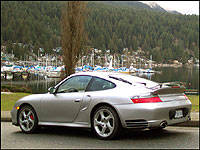 |
| Integrated into the next-generation Turbo's engine (2004 model shown),variable turbine blades "articulate to most effectively guide the flowof exhaust gases from the engine onto the turbocharger's turbinewheel." (Photo: Trevor Hofmann, Canadian Auto Press) |
The variable turbine blades, which "articulate to most effectively guide the flow of exhaust gases from the engine onto the turbocharger's turbine wheel," are the VTG system's core components.
Basically,
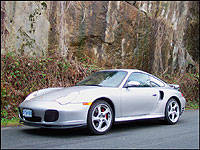 |
| For the time being, Porsche won't be placating 911 Turbo enthusiasts' with specific horsepower and torque ratings of its next-generation model (2004 model shown). (Photo: Trevor Hofmann, Canadian Auto Press) |
For the time being, Porsche won't be placating 911 Turbo enthusiasts' with specific horsepower and torque ratings, most likely leaving this critical announcement for a future auto show when its completely updated 911 Turbo gets introduced - definitely not Detroit but quite possibly Geneva or New York next year.