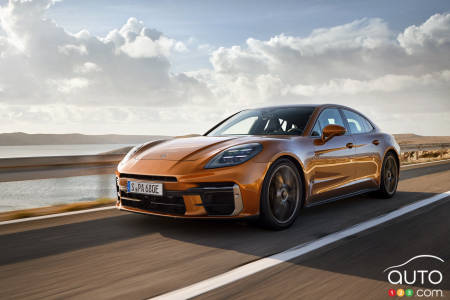
Porsche is considering merging its similar-sized Taycan (electric) and Panamera (gas-engine) models as part of an effort to save costs and streamline its lineup in future. We could see thus see the Taycan name disappear.
The reasoning behind the idea of bringing two models with different architectures and powertrain types under one banner may seem odd, but actually the vehicles are almost similar in their dimensions and Porsche is in full self-evaluation mode when it comes to costs, most notably in the electric sphere. Can the company justify developing and marketing two similar but distinct models? It may make more sense to fold one into the other, and offer the model as an electric side-by-side with the gas-engine variant. Porsche has already gone that route with the Macan and Cayenne SUVs, for which it offers parallel models built on different platforms, one for gas, one for electric.
The current Taycan is built on the J1 platform also used for the Audi e-tron GT, and the plan was for the next version (or successor) to switch to the upcoming SSP Sport architecture. The ICE Panamera, meanwhile, sits on the automaker’s MSB platform, which is also due to be replaced by the PPC architecture when the scheduled third-generation Panamera launches sometime between 2028 and 2030.
It’s reported that merging the models into one, but offered on two different platforms, would save the company a considerable sum in development and manufacturing costs.