


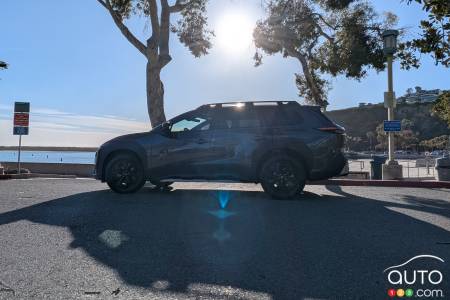



Subaru is accelerating its electric vehicle strategy, with the latest development a project to market a high-performance SUV engineered independently of its long-standing partner, Toyota. According to several media reports, an early prototype has been in testing at the automaker’s proving ground north of Tokyo. The vehicle is styled after an Outback wagon, though the automaker cautions the final design will likely be quite different.
The development process is also serving to test and preview a suite of next-generation EV technologies, which could enter Subaru production vehicles around 2029.
Subaru going all-electric in Europe by 2028
This bit of news comes the same week as the confirmation by Subaru of plans to retire the last of its gas-engine options in Europe by 2028. The Old Continent will then get only electric models, Subaru citing European Union emissions and driver-assistance requirements as a main driver for the move.
Subaru takes pain to make clear it will continue to offer gas-only and hybrid options in other markets.
EVs developed in-house
The plan to develop a high-performance EV marks a shift for Subaru, whose current lineup of four electric crossovers, including the Solterra, Trailseeker, Uncharted and Getaway was co-developed on shared Toyota architectures.
By developing a model separately, Subaru aims to deliver a distinct driving experience that echoes the handling dynamics of its iconic WRX while reclaiming its unique brand identity.

Performance and powertrain of the future Subaru electric SUV
The prototype is powered by a dual-motor, all-wheel-drive system delivering a combined output of around 510 hp, so it’s no chump power-wise. A front-mounted 150-kW (201-hp) motor pairs with a 230-kW (308-hp) rear motor to propel the test vehicle from 0 to 100 km/h in under four seconds.
The drive units were co-developed with Aisin, featuring a more compact and lighter design that yields motor efficiency roughly 30-percent above the industry average. Energy is supplied by a battery pack incorporating 4,000 cylindrical cells from Panasonic Energy.
Although capacity and total driving range have not been disclosed, Subaru says the pack is 25-percent lighter than its previous designs and targets an energy density 20 percent higher than industry averages.
The dedicated platform reduces overall weight by 100 kg compared to Subaru’s existing architectures. Safety enhancements include a redesigned front structure where the front motor is engineered to rotate during a crash to optimize collision absorption and preserve cabin integrity.
All those details are as reported by Japanese outlet Nikkei Asia.
Company executives emphasize that development remains in its early stages, and production greenlights or market availability for North America have not yet been finalized.