





A few hot (and wet) laps
The initial R8 track sessions took place at the Mosport Driver Development Track. Home to the Bridgestone Racing Academy, this track offers a challenging combination of turns, as well as some elevation changes. Trouble is, when the weather takes a turn for the worse, drainage can be a major issue.
The track session involved a few laps following an R8 driven by Uwe Fricker, an instructor with the Audi Driving Experience for many years. My objectives for this session were threefold: secure the car right behind the pace driver, stick to within two car lengths of the leader and attempt to find the limits of adhesion at the same time.
Mission accomplished on all fronts
Following the pace driver in close formation, I opted to keep the R8 planted on the dry racing line, despite the fact that the track was slick with moisture and surface oil. In a quick transition section, the car got completely out of shape and, although I counter-steered in response, I was headed straight off the track and onto the grass.
Luckily, the traction control system kicked in (the system can normally be disabled, but not for this track session) and a few tenuous moments later, the nose of the R8 was pointed in the right direction again. A close call.
A lap later, in another quick transition section before the longest straight, the dry line really didn't pay off. As I nudged the accelerator to keep up with Herr Fricker, the back end snapped out of shape, prompting some more counter-steering and a more prudent use of the throttle. Not so close a call, but an eye-opener nonetheless.
Next: the Mosport Grand Prix track and another pair of laps behind the pace car. This time, there were fewer opportunities to get the Audi out of shape - I maintained the dry line, but we were traveling at a lower rate of speed, so no major moments were in the offing.
Still and all, it was massive fun to drive the R8 in the wet. The one thing it highlighted is the car's very high level of grip and the way in which, when that level was exceeded, all four wheels lost traction at the same time. This makes the car's handling easy to predict and the car easy to recover.
The initial R8 track sessions took place at the Mosport Driver Development Track. Home to the Bridgestone Racing Academy, this track offers a challenging combination of turns, as well as some elevation changes. Trouble is, when the weather takes a turn for the worse, drainage can be a major issue.
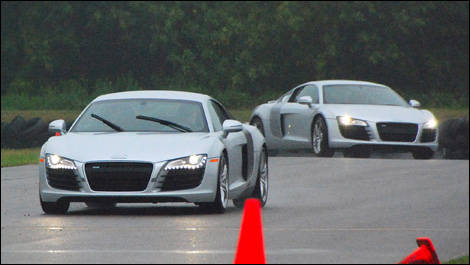 |
The track session involved a few laps following an R8 driven by Uwe Fricker, an instructor with the Audi Driving Experience for many years. My objectives for this session were threefold: secure the car right behind the pace driver, stick to within two car lengths of the leader and attempt to find the limits of adhesion at the same time.
Mission accomplished on all fronts
Following the pace driver in close formation, I opted to keep the R8 planted on the dry racing line, despite the fact that the track was slick with moisture and surface oil. In a quick transition section, the car got completely out of shape and, although I counter-steered in response, I was headed straight off the track and onto the grass.
Luckily, the traction control system kicked in (the system can normally be disabled, but not for this track session) and a few tenuous moments later, the nose of the R8 was pointed in the right direction again. A close call.
A lap later, in another quick transition section before the longest straight, the dry line really didn't pay off. As I nudged the accelerator to keep up with Herr Fricker, the back end snapped out of shape, prompting some more counter-steering and a more prudent use of the throttle. Not so close a call, but an eye-opener nonetheless.
Next: the Mosport Grand Prix track and another pair of laps behind the pace car. This time, there were fewer opportunities to get the Audi out of shape - I maintained the dry line, but we were traveling at a lower rate of speed, so no major moments were in the offing.
Still and all, it was massive fun to drive the R8 in the wet. The one thing it highlighted is the car's very high level of grip and the way in which, when that level was exceeded, all four wheels lost traction at the same time. This makes the car's handling easy to predict and the car easy to recover.
 |