





Now, let's take a look at a comparison of these vehicles' fuel economy.
You'll see how their fuel consumption numbers have evolved.
*References: http://www.fueleconomy.gov
(The information for the Porsche Carrera was not available, so it's not in the chart above)
As you can see, while a lot of effort was put into increasing horsepower in cars over the last 20 years, we can't say as much for fuel economy. While the compiled numbers on engine power in this research show an increase from 40% to 120%, gains in fuel consumption are just about inexistent. Some small increases, decreases or figures that haven't changed in 20 years. The least we can say is that these numbers are far from impressive from an economic standpoint, and since greenhouse gas emissions are directly related to fuel consumption, we can conclude that no progress has been made in 20 years on this subject.
Although the sample here is only 6 vehicles, the fact is that for the vast majority of the models on the market, the results are roughly the same. Lots more horsepower, very little gains in fuel economy.
But... how?
Do you wonder how we managed to drive around with cars that had so few horsepower? Or did we just get too fat? Was it possible to follow the flow of traffic? Like you've probably seen in the pictures, these vehicles weren't necessarily a lot smaller than the actual models; especially the Honda Accord and Ford Taurus. Some of my friends have owned each of these models. And no one, from the Corolla to the Porsche, has said to me: "What a dog! I can't get where I want to go!" or "this engine is not really powerful enough!" Well, no! Since everyone was driving vehicles about as powerful as the others in their respective categories, nobody was complaining.
Let's not forget that, following the horsepower race in the sixties, the oil crisis was a hard hit on the wallet of every driver on the planet and American manufacturers. A lot of automotive "enthusiasts" have kept a bitter taste of the 1976-1990 period when, according to them, cars weren't really interesting (read: powerful and nice to look at).
You'll see how their fuel consumption numbers have evolved.
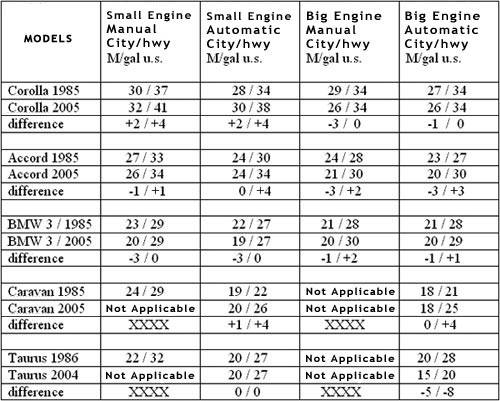 |
*References: http://www.fueleconomy.gov
(The information for the Porsche Carrera was not available, so it's not in the chart above)
As you can see, while a lot of effort was put into increasing horsepower in cars over the last 20 years, we can't say as much for fuel economy. While the compiled numbers on engine power in this research show an increase from 40% to 120%, gains in fuel consumption are just about inexistent. Some small increases, decreases or figures that haven't changed in 20 years. The least we can say is that these numbers are far from impressive from an economic standpoint, and since greenhouse gas emissions are directly related to fuel consumption, we can conclude that no progress has been made in 20 years on this subject.
Although the sample here is only 6 vehicles, the fact is that for the vast majority of the models on the market, the results are roughly the same. Lots more horsepower, very little gains in fuel economy.
But... how?
Do you wonder how we managed to drive around with cars that had so few horsepower? Or did we just get too fat? Was it possible to follow the flow of traffic? Like you've probably seen in the pictures, these vehicles weren't necessarily a lot smaller than the actual models; especially the Honda Accord and Ford Taurus. Some of my friends have owned each of these models. And no one, from the Corolla to the Porsche, has said to me: "What a dog! I can't get where I want to go!" or "this engine is not really powerful enough!" Well, no! Since everyone was driving vehicles about as powerful as the others in their respective categories, nobody was complaining.
Let's not forget that, following the horsepower race in the sixties, the oil crisis was a hard hit on the wallet of every driver on the planet and American manufacturers. A lot of automotive "enthusiasts" have kept a bitter taste of the 1976-1990 period when, according to them, cars weren't really interesting (read: powerful and nice to look at).