





This model is said to reaffirm Ferrari's "strong link between its GT and sporting divisions," since it is specifically designed to meet the expectations of its sportier clients.
The F430 Challenge therefore retains the same general look and 490-hp engine as the road-going version, but it also incorporates a large number of significant track-oriented modifications and a host of new features not
seen in the car currently used in the series. That would be the 360 Challenge, which the F430 joins on the track next season and completely replaces in 2007.
Furthermore, an intensive series of development tests held at Fiorano and other prestigious circuits have honed the F430 Challenge's talents. In fact, says Ferrari, "it offers a stunning series of features sure to meet with the approval of its drivers. As ever, the transfer from Formula 1 is significant, particularly with regard to the braking system which uses carbon-ceramic material (CCM) -- a first for a Ferrari sports competition car."
The electronic gearbox is also said to be F1-derived and works in exactly the same way as the unit used aboard the Grand Prix car. Thanks to a two-plate clutch and specific software, it also offers the same gear-changing times as the road-going F430, though in the much more extreme track conditions.
To make the most of the engine on all of the circuits where the F430 Challenge will race, the Fifth and sixth gear ratios have also been modified from the road-going version. Slick 19-inch tires were also developed specifically by Pirelli for the race model, and are designed "to comply with the very strict racing regulations that demand endurance whilst still delivering blistering performance."
The F430 Challenge has a curbweight of just 1,225 kg, only that excludes fuel. Ferrari says weight has been reduced in every area of the car, from the engineering to the bodywork. Of particular note are the Lexan windscreen, the all-carbon fibre intake plenum cover, and the specific exhaust system.
To ensure that drivers get the full benefit of the car's sporty prowess on the track, the E-Diff has been replaced by a mechanical differential and the EBD has been replaced with a mechanical system.
Similarly, the stability and traction control have been permanently
disengaged and "race" settings have been maintained on the gearbox and engine management system, along with the ABS and ASR, thus doing away with the "manettino" switch. The ASR can be deactivated by the driver at will.
A particularly unique feature of the F430 Challenge is the steering wheel with a quick release mechanism to make it easier to get into and out of the car, and buttons for radio contact with the pits, to set the pit lane speed and interface with the new colour digital instrument panel.
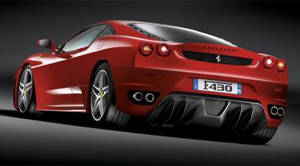
The rear of the car features a new exhaust system with high central tailpipes, and a modified grille which increases the extraction of hot air from the rear of the engine bay.
To increase the F430's skill on the track, the anti-roll bars, springs and single-rate shocks have also been modified. Finally, the centre locking wheels and built-in pneumatic jacks make tire changes faster.
photo:Bentley Motors and Ferrari
The F430 Challenge therefore retains the same general look and 490-hp engine as the road-going version, but it also incorporates a large number of significant track-oriented modifications and a host of new features not
 |
| Ferrari F430 Challenge |
Furthermore, an intensive series of development tests held at Fiorano and other prestigious circuits have honed the F430 Challenge's talents. In fact, says Ferrari, "it offers a stunning series of features sure to meet with the approval of its drivers. As ever, the transfer from Formula 1 is significant, particularly with regard to the braking system which uses carbon-ceramic material (CCM) -- a first for a Ferrari sports competition car."
The electronic gearbox is also said to be F1-derived and works in exactly the same way as the unit used aboard the Grand Prix car. Thanks to a two-plate clutch and specific software, it also offers the same gear-changing times as the road-going F430, though in the much more extreme track conditions.
To make the most of the engine on all of the circuits where the F430 Challenge will race, the Fifth and sixth gear ratios have also been modified from the road-going version. Slick 19-inch tires were also developed specifically by Pirelli for the race model, and are designed "to comply with the very strict racing regulations that demand endurance whilst still delivering blistering performance."
The F430 Challenge has a curbweight of just 1,225 kg, only that excludes fuel. Ferrari says weight has been reduced in every area of the car, from the engineering to the bodywork. Of particular note are the Lexan windscreen, the all-carbon fibre intake plenum cover, and the specific exhaust system.
To ensure that drivers get the full benefit of the car's sporty prowess on the track, the E-Diff has been replaced by a mechanical differential and the EBD has been replaced with a mechanical system.
Similarly, the stability and traction control have been permanently
 |
| Ferrari F430 Challenge |
A particularly unique feature of the F430 Challenge is the steering wheel with a quick release mechanism to make it easier to get into and out of the car, and buttons for radio contact with the pits, to set the pit lane speed and interface with the new colour digital instrument panel.
The rear of the car features a new exhaust system with high central tailpipes, and a modified grille which increases the extraction of hot air from the rear of the engine bay.
To increase the F430's skill on the track, the anti-roll bars, springs and single-rate shocks have also been modified. Finally, the centre locking wheels and built-in pneumatic jacks make tire changes faster.
photo:Bentley Motors and Ferrari


Article Gallery