





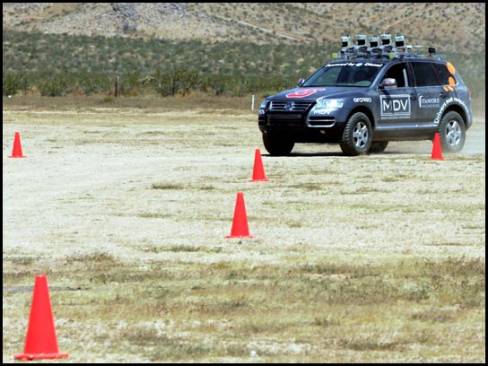
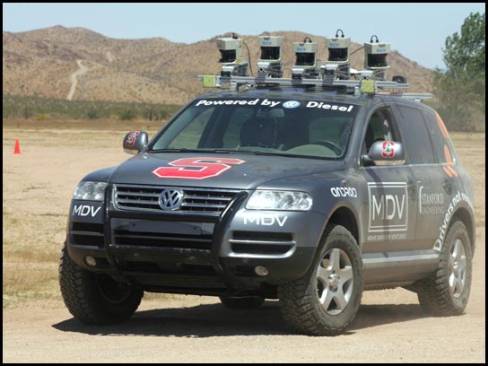
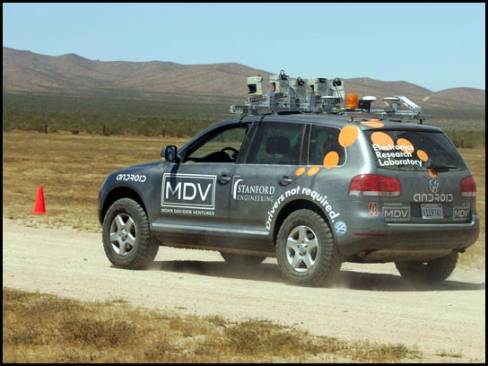
The systems also use stereo visual equipment, high-tech 24-GHz radar systems and a highly accurate, satellite-supported GPS navigation system, which depicts the position of the vehicle digitally to the exact millimetre.
This concentrated flood of information goes to the high-performance computer centre in Stanley's trunk, which is made up of seven networked Pentium M motherboards each with a 1.6 GHz processor.
Rabe says this system uses complex and unique software to determine the steering, acceleration and braking commands needed to control Stanley electronically via "drive-by-wire" systems. It's so sophisticated, he says, that it can react to the special features of the road in real-time.
Stanley and the vehicle that took part in the test session at Oschersleben were built in a few weeks, Rabe says.
Both vehicles were created in a collaboration between the Volkswagen research department, Volkswagen Group's Electronics Research Laboratory (ERL) in Palo Alto, California, and Stanford University.
Autonomous driving basically forms one of the main research subjects of the ERL, Rabe says. "Its implementation represents an immense scientific and technical challenge, and many aspects of the autonomous automobiles will eventually be used in other, more conventional driver assistance systems."
Dr. Carlo Rummel, the head of the ERL, says, "In this joint project, we are using the unique chance to work with one of the most renowned universities and prove what is currently technically possible. Of course, the competitive character ensures additional motivation among the team."
Momentarily replacing his academician's mortar board for a marketer's cap, Rummel adds that "the competition itself is an ideal stage to demonstrate the outstanding off-road capabilities of the Touareg."
Last year, the Defense Advanced Research Projects Agency (DARPA) of the U.S. government staged the Grand Challenge project for the first time, offering US$1 million in prize money. For 2005, that has been raised to US$2 million.
The 2005 Grand Challenge will take a 282-km trip through the Southwest desert, on a route that is not revealed until 10 hours before the start on October 8. Importantly, no driver or operator intervention is allowed.
Says Professor Sebastian Thrun of the Stanford Racing Team, "This is the first long-distance race in the history of the automobile in which the vehicles themselves make all of the decisions needed to progress. In other words: The car not only needs a strong body, but also a particularly intelligent mind."
photo:Volkwagen AG
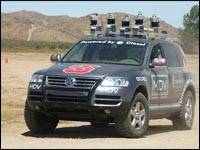 |
| Volkswagen Touareg off-road (photo: VAG) |
Rabe says this system uses complex and unique software to determine the steering, acceleration and braking commands needed to control Stanley electronically via "drive-by-wire" systems. It's so sophisticated, he says, that it can react to the special features of the road in real-time.
Stanley and the vehicle that took part in the test session at Oschersleben were built in a few weeks, Rabe says.
Both vehicles were created in a collaboration between the Volkswagen research department, Volkswagen Group's Electronics Research Laboratory (ERL) in Palo Alto, California, and Stanford University.
Autonomous driving basically forms one of the main research subjects of the ERL, Rabe says. "Its implementation represents an immense scientific and technical challenge, and many aspects of the autonomous automobiles will eventually be used in other, more conventional driver assistance systems."
Dr. Carlo Rummel, the head of the ERL, says, "In this joint project, we are using the unique chance to work with one of the most renowned universities and prove what is currently technically possible. Of course, the competitive character ensures additional motivation among the team."
Momentarily replacing his academician's mortar board for a marketer's cap, Rummel adds that "the competition itself is an ideal stage to demonstrate the outstanding off-road capabilities of the Touareg."
Last year, the Defense Advanced Research Projects Agency (DARPA) of the U.S. government staged the Grand Challenge project for the first time, offering US$1 million in prize money. For 2005, that has been raised to US$2 million.
The 2005 Grand Challenge will take a 282-km trip through the Southwest desert, on a route that is not revealed until 10 hours before the start on October 8. Importantly, no driver or operator intervention is allowed.
Says Professor Sebastian Thrun of the Stanford Racing Team, "This is the first long-distance race in the history of the automobile in which the vehicles themselves make all of the decisions needed to progress. In other words: The car not only needs a strong body, but also a particularly intelligent mind."
photo:Volkwagen AG
Article Gallery