A Chivalrous Yet Highly Athletic ImportSometimes the simplest things deliver the greatest impact. Take for example the
2006 VW Passat 2.0T. It's equipped
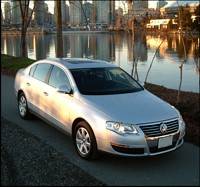 |
| With the Passat, Volkswagen has put a lot of thought into the seemingly little things that often make a daily commute more enjoyable. (Photo: Rob Rothwell, Canadian Auto Press) |
with a cutting-edge, 2.0-litre (122 cu in) direct-injection turbocharged powerplant feeding into a 6-speed Tiptronic autobox. While impressive, what drew a smile to my cheeks wasn't the Passat's sizzling drivetrain but rather the expandable 'VW' umbrella that resides within a cylindrical slot located in the driver's door, accessible only when the door is open. There's nothing hi-tech about this keep-dry arrangement, yet it's a thing of beauty, especially to motorists living in the West Coast rainforest; often referred to as the Wet Coast for obvious reasons (not to mention Left Coast, at least in Vancouver and on the Island... Ed.).
Also obvious is the Passat's larger size and its new styling, the latter highlighted by a bold chrome nose and scalloped headlights. For me, the jury is still out on whether the shape of VW's revised midsize offering is an
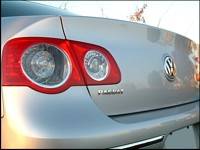 |
| For me, the jury is still out on whether the shape of VW's revised midsize offering is an improvement over its outgoing 2005 shape or not. (Photo: Rob Rothwell, Canadian Auto Press) |
improvement over its outgoing 2005 shape or not. I was a real fan of the previous generation Passat, which was first introduced way back in 1998; that was a long time ago in car years, so a reworking was definitely in order if VW is to attract newfound attention. But beyond street appeal, the latest Passat has what it takes to attract attention from new and existing customers alike.
The Passat remains a front-wheel-drive (FWD), 4-door sedan capable of seating five adults. In addition to more interior real estate, larger exterior dimensions and a longer wheelbase, the new VW packs more punch regardless of whether the optional, narrow-angle V6 or turbocharged inline 4-cylinder mill is tucked beneath its hood. In the case of this week's tester, the 4-banger whirled away,
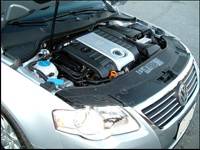 |
| The Passat 2.0T's 4-banger whirled away, spinning out 200-horsepower and a significant 207 foot-pounds of torque (that's up 30-horsepower and 41 foot-pounds of torque over last year's 1.8-litre non-FSI engine). (Photo: Rob Rothwell, Canadian Auto Press) |
spinning out 200-horsepower and a significant 207 foot-pounds of torque (that's up 30-horsepower and 41 foot-pounds of torque over last year's 1.8-litre non-FSI engine). Unlike a typical 2.0-litre 4-cylinder powerplant, the Passat's turbo'd version kicks out its maximum torque at only 1,800 rpm, and keeps it there until the tach crests 5,000 rpm. Along the way, this punchy mill never runs out of breath or emits anything other than a truly refined, although slightly frenetic, exhaust note.
The 2.0T's pulling-power is really quite astonishing. In fact, keeping the front wheels from breaking traction and spinning like dynamos can be tricky when wanting to steam away from a light or slingshot ahead of slower traffic. The instant hit of power is attributable in part to the delivery of maximum torque at low rpm levels, as
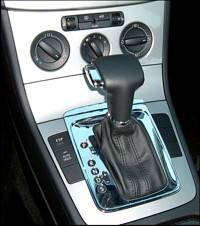 |
| The availability of five more gears maximizes acceleration well into legal and highly illegal realms, resulting in outstanding passing performance for a 4-cylinder, automatic-equipped sedan. (Photo: Rob Rothwell, Canadian Auto Press) |
well as to a low-ratio first gear. When auto manufacturers have the luxury of dividing a broad powerband among six forward gears, they can maximize out-of-the-hole take-off with the use of a very low-ratio first gear, such as in the Passat, without sacrificing fuel savings brought about by tall overdrive gears in the upper ranges.
The availability of five more gears maximizes acceleration well into legal and highly illegal realms, resulting in outstanding passing performance for a 4-cylinder, automatic-equipped sedan, tipping the scale at 1,520 kg (3,344 lb). Volkswagen claims a 0 to 100 km/h time of just 7.4 seconds for the largest Passat ever, when the DOHC 2.0T is propelling it through the Tiptronic autobox; interestingly it felt faster, leading me to believe that 7.4 seconds is a conservative measure. When the standard equipment 6-speed manual transmission is looped in, VW hangs a 6.9-second time-tag on a run to 100 km/h. Like a good receiver in football, the Passat's forward energy is complemented by its lateral agility.