





Ford managed to enhance the car's handling, due to a new wheel and tire package, recalibrated power speed-sensitive power steering and more structural rigidity in the unibody design. Still its driving dynamics were by no means world class yet good for a domestic sedan. New upper strut mounts improved NVH levels, as did the previously mentioned tweaks.
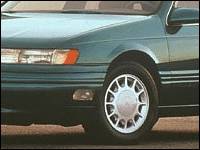 |
| Four-wheel disc brakes were standard from 1992 through 1995 while ABS was available. (Photo: Ford Motor) |
Four wheel disc brakes were standard with available ABS, a big step for 1992. Still, front passenger and side impact airbags, traction control and many of the other safety features we now take for granted weren't available. Despite these exclusions the Taurus posted good crash results for driver and passengers in offset tests, side impact front, rear and rollover testing reportedly wasn't done.
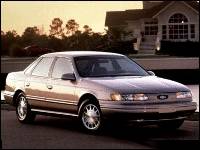 |
| Model year 1995 brought the Ford Taurus SE sedan to market. (Photo: Ford Motor) |
The interior was improved ergonomically, with more comfortable and better quality velour cloth seats, larger audio system controls and a better dash layout. Standard features included a driver side airbag, AM/FM stereo, digital clock, intermittent wipers, tilt steering column, power steering and brakes, power mirrors and tinted glass. The upgraded LX added air-conditioning, alloy wheels, a remote trunk release, plus power windows, door locks, and driver's seat.
The 1993 model year added nothing to the standard equipment list in the base GL but a 5 lb-ft increase in torque to the 3.0-L engine. A passenger airbag was now standard on the LX as well. Model year 1994 added dual front airbags to the GL at no extra charge, while the LX now came with standard front bucket seats, a center console, special bodyside cladding, a lighted entry system and a tachometer.