





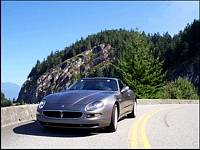
The car's controlled stability is due to a combination of elements starting with the unique rear transmission placement, resulting in a 53% front and 47% rear weight distribution. I happen to know every tantalizing curve on the controversial stretch of highway that connects West Vancouver to Whistler, BC - the chosen course for this test - like few others, allowing me to premeditate advancing corners prior to breaking (not braking) each inanely low 'slow to 30 km/h' speed limit, thus optimizing my 'track' speed. I've driven this roadway in everything from my old '96 Dodge Caravan to the latest BMW M3 SMG, and only the latter as well as a particularly sweet 2001 Porsche Turbo, came close to the Maserati's dynamic handling.
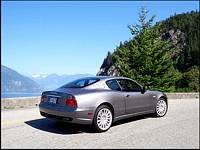
And it's no wonder. A quick glance at the parts of its sum and it's obvious why it dances so well. Its lightweight alloy constructed double-wishbone suspension geometry incorporates anti-dive characteristics up front, while a toe-in regulator bar works in tandem with the drivetrain to optimize at-the-limit grip out back. Forged aluminum hubs and struts, pre-set steel shocks or optional continuous adjustment aluminum shocks with acceleration sensors - the latter setup part of the Skyhook suspension system - combined with coaxial coil over springs, front and rear, are the ultra-tech tidbits that keep it locked to the pavement.