





Whatever you learned in driving school about shifting a manual transmission, I'm told to forget about when at the wheel of the Esprit. 'Slowly release clutch, add gas,' simply does not work. The heavy-duty clutch is designed to catch hard and fast meaning the best way to get moving is to give the gas pedal a good stomping while lifting your left foot up. Get
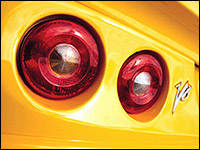 |
| If the heavy-duty clutch is handled properly, the Esprit can go from 0 to 100 km/h in a mere 4.5 seconds. (Photo: Lotus) |
In the former scenario 100 km/h arrives in a mere 4.5 seconds, and with the shriek of the V8 in back, hissing turbos forcing driver and passenger along, it's only a matter of seconds before hitting the rev limiter at maximum speed - that incidentally reaches 290 km/h in top gear.
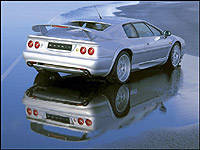 |
| A simple tubular frame clothed in fiberglass panels keeps the Esprit's weight down to 1,380 kilograms. (Photo: Lotus) |
What makes this immediate forward thrust possible, even with what can only be deemed as moderate levels of horsepower for its supercar status, is superior weight management. Lotus manages the Esprit's overall lightweight without the use of high-tech materials or complex structures, but rather delivers up fairly conventional and proven methodology. A simple tubular frame clothed in fiberglass panels keeps the weight down to 1,380 kilograms (3,042 lbs).
Double wishbone suspension components are fitted all around, as are beefed up anti-roll bars. Suspension travel seems limited to the thickness of a sheet of paper, and it's all served up with a near perfectly balanced chassis and razor-sharp steering. A Bilstein adjustable suspension is now available as well, adding about $3,000 to the price.