The car's 215-hp 3.2-liter V6 delivers an impressively robust 229 lb-ft of torque from as low as 3,000 rpm, through either a standard 6-speed manual or 5-speed automatic with manual mode, driving the rear wheels. While the positive shifting manual would be my choice, the automatic is well suited to the torquey engine. It's not particularly quick to shift, but it's oh so smooth with perfectly set intervals and a wonderfully engaging AutoStick manual mode.
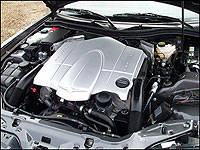 |
| The Roadster's 215-hp 3.2-liter V6 engine, available with either a 6-speed manual or a 5-speed automatic transmission, is impressive. (Photo: Trevor Hofmann, Canadian Auto Press) |
That tall torque rating puts it into the category of few, outclassing the Audi TT quattro at 207 lb-ft, BMW Z4 at 214 and Porsche Boxster at only 192. But hold on, the torque figures shown for the Audi and BMW rivals are for the much more expensive upgraded engines. Base output equals 184-hp and 175 lb-ft of torque for the Z4 and 180-hp and 173 lb-ft for the TT. The Crossfire Roadster's 215-hp and 229 lb-ft of torque is noticeably more plentiful than its base-equipped rivals, accepting the 287-hp Nissan 350Z roadster of course, with its 274 lb-ft of torque. That said the Nissan will not appeal to those who gravitate towards high-quality interiors while its ride is quite punishing. The new SLK sports more power for 2005 too, but its price point puts it into a different league altogether.
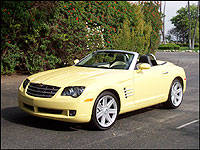 |
| On most road surfaces the Crossfire is one of the smoothest riding sports cars available, without sacrificing handling. (Photo: Trevor Hofmann, Canadian Auto Press) |
Once off the freeway, which I have to admit is a little unsettling to the Crossfire Roadster's short wheelbase due to the roadway's concrete construction and continual expansion joints, my co-driver and I were off to the hills. To be fair to the Crossfire, this back-and-forth bobbing effect would happen with any short-wheelbase vehicle. On every other surface the Crossfire is one of the smoothest riding sports cars available, absorbing bumps, dips and other road imperfections with an unusual civility. Its extremely rigid body structure, incorporating a torsional stiffness of 29.2 Hz, allows Chrysler's engineers to set the suspension up slightly softer than what would be necessary on a car that flexes more while still achieving the same level driving dynamic.