That midgate cancels out the rear seats, which incidentally are otherwise accessible via a single rear half-door that hinges at the passenger-side rear
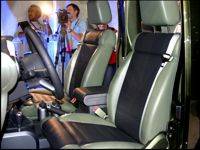 |
| The rear seats aren't as large and accommodating as those up front, but would be handy when transporting four adults or perfectly suitable for hauling around a family of four, providing the kids were smaller in size. (Photo: Trevor Hofmann, Canadian Auto Press) |
and opens up clamshell-like. There's no rear driver's side door, as it would open up into the spare tire, but rather a tiny half-door allows access to cargo that might be stored in the rear seating area. Nevertheless, I like the way Jeep makes the cab seem smaller than it really is, by tapering the body shell inward as it meets up with the cargo box. The rear seats aren't large, but would be handy when transporting four adults was necessary or perfectly suitable for hauling around a family of four, providing the kids were smaller in size.
Speaking of smaller in size, the Gladiator isn't a midsize truck like its Dodge Dakota cousin, a market segment that is now becoming more popular than the old compact sized pickup category. Its compact exterior dimensions and rather light
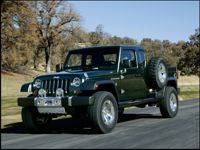 |
| The Gladiator's compact exterior dimensions and rather light curb weight are closer to the Chevy Colorado/GMC Canyon duo, or Ford's Ranger than the Dakota or Toyota's new Tacoma. (Photo: DaimlerChrysler Canada) |
curb weight are closer to the Chevy Colorado/GMC Canyon duo, or Ford's Ranger than the Dakota or Toyota's new Tacoma, which might be ideal for its primary role as off-road pickup truck leader but probably not helpful if Jeep has plans of making its new light truck entry anything but a small player. Of course, current market trends could shift toward smaller trucks if fuel costs keep rising exponentially, which would leave the current Gladiator optimally sized for success. And besides, Dodge already has the midsize segment sewn up with its Dakota, so why not try and dominate the compact market with a Jeep?