 |
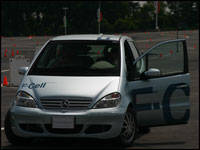
| The F-Cell's performance makes it quite suitable for everyday use, and like a gasoline-electric hybrid doesn't need to be plugged in. (Photo: Trevor Hofmann, Canadian Auto Press) |
You want to know the exact acceleration numbers? OK. The car's electric motor has an output of 65 kW, propelling the A-Class F-Cell from 0 to 100 km/h in about 16 seconds, 3 to 4 seconds quicker than the diesel-powered smart fortwo, and goes on to achieve a top speed of around 140 km/h (87 mph). As can be seen, such performance makes the F-Cell quite suitable for everyday use, and like a gasoline-electric hybrid doesn't need to be plugged in to recharge its batteries - that task taken care of by the hydrogen fuel cell system.
The A-Class is eerily quiet and FCV's power delivery quite smooth, however, and while motivated by an altogether foreign mechanical device is about as user friendly as I could have hoped for. This is mostly due to a fairly conventional cockpit, at least conventional as far as A-Class models go. The car is not imported by Mercedes-Benz Canada, at least not yet, which is a shame as I think it would do very well here. It just might be one of the most effective uses of space in the automotive industry, featuring more front and rear legroom than many cars twice its size, plus a very roomy cargo area accessible via a large hatch opening.
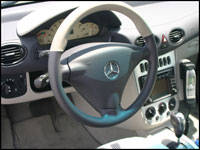 |
| The user-friendliness is mostly due to a fairly conventional cockpit, at least conventional as far as A-Class models go. (Photo: Trevor Hofmann, Canadian Auto Press) |
The weather during testing was blisteringly hot and to make matters less bearable, stiflingly humid, which is hardly unusual in and around DC this time of year. But such temperatures and air density is no problem for the F-Cell. These extreme weather conditions are the same reasoning behind Mercedes-Benz choosing to test its long-term FCVs in Singapore, important to find out how the car's systems hold up over the long haul. Tropical temperatures, which is the case for Singapore at least, with high humidity levels place greater demand on a fuel cell's production of steam emissions, as well as on its cooling systems.