





 |
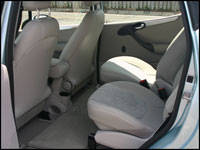
| The FCV features more front and rear legroom than many cars twice its size, plus a very roomy cargo area. (Photo: Trevor Hofmann, Canadian Auto Press) |
If you weren't aware, and I certainly wasn't prior to a host of DaimlerChrysler engineers expounding the attributes of one of North America's top-most automotive employers, the automaker undertook the largest trial of fuel cell vehicle of any manufacturer worldwide in 2003. The test includes, as it remains ongoing, more than one hundred cars, vans and buses, used in various climates, hot and cold, around the world.
For instance, UPS is testing fuel cell-equipped Sprinter vans within its U.S. fleet, and 30 fuel cell-powered Mercedes-Benz Citaro city buses are in operation within ten European cities. We were transported from the convention centre downtown to the FedEx Field in one of these, and it was as nicely appointed and as capable on highways and byways as any passenger bus I've had the pleasure of riding in.
Of the models being tested in DCX's worldwide program, the greatest
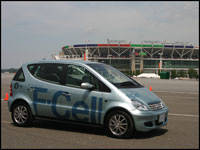 |
| In the A-Class FCV, the fuel cell functions as an on-board electrochemical energy converter for generating energy from hydrogen to power the electric motor. (Photo: Trevor Hofmann, Canadian Auto Press) |
Prior to putting the F-Cell into series testing, 1994's NECAR (New Electric Car) pioneered DaimlerChrysler's advanced fuel cell technology. This was followed by an amazing twenty fuel cell-equipped concept vehicles. In the A-Class FCV, the fuel cell functions as an on-board electrochemical energy converter for generating energy from hydrogen to power the electric motor, which in turn powers the wheels. Since the early NECAR and early concepts that followed, the drive unit's size and weight have been reduced considerably, improving performance significantly.