





If you've forgotten that the 911 is a rear-engine car, also remember that it is a 2 + 2. As in every 911 that came before, the top half of the rear seats fold to allow for a flat storage. Leaving my family behind for this trip, it makes a great spot for my overnighter and camera bag.
Escaping urban then subsequently suburban traffic, I start in on my very non-direct route to The Big Smoke. The cottage country roads have been plowed, but the trucks have left a concoction of sand and gravel to spice things up a bit. The area's roads high crown design has allowed the curbsides to be left with a mix of packed snow and ice. Add corners d
eveloping transverse-running streams from melting runoff and I'm starting to think the smart-ass gas attendant may have been on to something.
Even on these frost-heaved backroads, the suspension is fairly limber with little or no float. Its stiff enough to keep the chassis moving as little as possible, but there's plenty of information still being transferred through the steering wheel. The 997's wheelbase and front-strut and rear-multilink suspension caries over with minor tweaks from the 996. Porsche claims drag coefficient is down from 0.30 to 0.28 (Carrera) and 0.29 (Carrera S), front and rear lift have also been reduced, and there is now a flush-fitting undertray. In lieu of more standard features, a broader body, and better crash protection, curb weight has only increased by 25 kilograms to 1,420.
The two biggest reasons I manage to keep this big-powered, rear-engine sports car out of the snow-covered evergreens is down to the winter Continental tires and Porsche's Active Suspension Management. Standard on the Carrera S, PASM mates a lower ride height and tighter springs with four electronically controlled shocks. You can select between two different settings: Normal is fundamentally for cruising until faster driving automatically triggers a tauter mode; Sport buttons down the shocks immediately.
Compared to the last 996 model I drove, the brand-new six-speed stick is much faster and smoother with the clutch being less of a Nautilus workout. Like the electronic systems found in newer BMW's, the Porsche 911's new variable rate steering feels less secure around the straight-ahead position. When you are in the twisties, it does turn in more quickly and is not as affected by any road irregularities. In theory, the ratio quickens the farther you turn the wheel, but I don't notice it after an hour of backroad boogying.
Centered atop the dash, in what appears to be an Infiniti-mimicking stab at faux luxury is actually a chronograph stopwatch. It's the most obvious feature of the $1,290 Sport Chrono Pack Plus option. Activated by the left steering-column stalk, you can time yourself from point-to-point on your next track day, returning late DVDs to Blockbuster, or even on the Snow Road on a February day. More than just an expensive stop watch, when activated, it actually heightens the PASM, accelerates response, permits higher revs, and loosens the reins on the stability control for those who know how to drive.
Even more important is the new 911's brakes. Appropriated from the 996 911 Turbo, the brakes have four-piston monoblock calipers and are an improvement on the already stellar system thanks to a larger booster. Ceramic composite discs are available as an option.
Escaping urban then subsequently suburban traffic, I start in on my very non-direct route to The Big Smoke. The cottage country roads have been plowed, but the trucks have left a concoction of sand and gravel to spice things up a bit. The area's roads high crown design has allowed the curbsides to be left with a mix of packed snow and ice. Add corners d
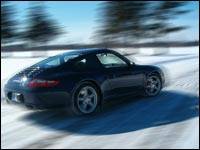 |
| (Photo : John LeBlanc, straight-six.com) |
Even on these frost-heaved backroads, the suspension is fairly limber with little or no float. Its stiff enough to keep the chassis moving as little as possible, but there's plenty of information still being transferred through the steering wheel. The 997's wheelbase and front-strut and rear-multilink suspension caries over with minor tweaks from the 996. Porsche claims drag coefficient is down from 0.30 to 0.28 (Carrera) and 0.29 (Carrera S), front and rear lift have also been reduced, and there is now a flush-fitting undertray. In lieu of more standard features, a broader body, and better crash protection, curb weight has only increased by 25 kilograms to 1,420.
The two biggest reasons I manage to keep this big-powered, rear-engine sports car out of the snow-covered evergreens is down to the winter Continental tires and Porsche's Active Suspension Management. Standard on the Carrera S, PASM mates a lower ride height and tighter springs with four electronically controlled shocks. You can select between two different settings: Normal is fundamentally for cruising until faster driving automatically triggers a tauter mode; Sport buttons down the shocks immediately.
Compared to the last 996 model I drove, the brand-new six-speed stick is much faster and smoother with the clutch being less of a Nautilus workout. Like the electronic systems found in newer BMW's, the Porsche 911's new variable rate steering feels less secure around the straight-ahead position. When you are in the twisties, it does turn in more quickly and is not as affected by any road irregularities. In theory, the ratio quickens the farther you turn the wheel, but I don't notice it after an hour of backroad boogying.
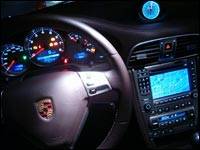 |
| (Photo : John LeBlanc, straight-six.com) |
Even more important is the new 911's brakes. Appropriated from the 996 911 Turbo, the brakes have four-piston monoblock calipers and are an improvement on the already stellar system thanks to a larger booster. Ceramic composite discs are available as an option.