





Half of the Japanese luxury division's claim; that the 400h would accelerate like a V8 while delivering the fuel economy of a 4-cylinder, was validated during these high-speed runs down the Hilo Drag Strip.
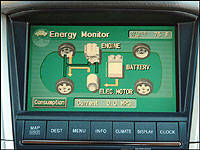 |
| The 400h accelerates like a V8 while delivering the fuel economy of a 4-cylinder. (Photo: Lexus) |
So what about its fuel economy? While official EPA numbers aren't in yet, Lexus expects the 400h to achieve 7.8 L/100 km in the city and 9.1 L/100 km on the highway, which not only slaughters the V8 competitors previously mentioned, at 16.4 / 12.5 L/100 km city / highway for the ML500, 14.8 / 9.9 for the BMW X5 4.4i and 15.6 / 11.2 for the Infiniti FX45, but also bests the same vehicles' 6-cylinder fuel consumption results, at 14.4 / 9.9 city / highway for the Infiniti FX35, 14.9 / 10.4 for the BMW X5 3.0i, and 15.5 / 12.0 for the Mercedes-Benz ML350. Also of note, the RX's Acura MDX rival is thirstier too.
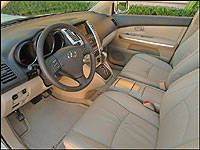 |
| The 400h is even more luxurious than the conventionally powered RX 330. (Photo: Lexus) |
But beating out competitive V6 powertrains doesn't help it live up to the claim of 4-cylinder-like fuel consumption. True, but just hold on, I haven't got to that part yet. Compared to various compact SUVs, which don't have to carry around anywhere near as much weight, the 400h is more efficient than all while driving through the city. Only on the highway do the little SUVs improve on the hybrid Lexus, and not by much.
Interestingly, when factoring in the average fuel consumptions of compact sedans, at 8.52 L/100 km, which are lighter and generally more fuel efficient than compact SUVs, the RX 400h's combined rating of 8.4 L/100 km is even more efficient.
But enough about saving money and the environment, compared to such back to basics transportation the 400h is hedonistic, at least in creature comforts. It's even more luxurious than the conventionally powered RX 330. Inside, brushed aluminum accents add a technical appearance, while the tachometer has been replaced with a power meter.