





New Convertible Jaguar Critical for Meeting Future Sales Targets
It was only a matter of time before Jaguar presented a convertible version of its all-new XK sports car; it just so happens that the time between announcements was measured not by months or weeks, but by a matter of days. With the official unveiling of the XK during the press media days of the Frankfurt motor show, Jaguar took the opportunity to show off the open-topped variant.
The legendary British marque claims that the Convertible was engineered and designed side by side with the coupe from the start, as a completely new model in the XK design program. This made for several useful benefits, such as being able to present a complete, pre-production model in Frankfurt, but developing and then building both models at once also prevented unnecessary and often expensive post-production modifications.
Like the Coupe, the XK Convertible makes use of the same revolutionary aluminum monocoque technology also found in the full-size XJ sedan. Unlike Audi's ASF space frame, employed in the A2 and A8, the system in the XK uses rivets and epoxy resin for added strength. Jaguar claims that the car tips the scale at just 1,635 kg (3,605 lbs), making it the lightest
car in its class of four-seat grand touring convertibles, but still nowhere near as lightweight as the 1,451 kg (3,199 lb) fiberglass-bodied Corvette Convertible - albeit the American model is only a two-seat roadster.
While the previous generation XK Convertible wasn't exactly what I'd call a purist's sports car, mostly due to its substantial girth and flexing body structure, the new vehicle's more rigid construction, lighter curb weight, sophisticated suspension and, reportedly, communicative steering system should forge a new image for Jaguar. Some of that structural rigidity comes from extra bracing under the car's skin and, it could be said because of the aluminum skin itself. Add this to the additional electric components required for the folding soft top roof, and the weight penalty is surprisingly small at just 40 kg (88 lbs).
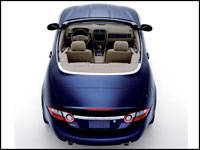 |
| The Convertible was engineered and designed side by side with the coupe from the start. (Photo: Jaguar Canada) |
The legendary British marque claims that the Convertible was engineered and designed side by side with the coupe from the start, as a completely new model in the XK design program. This made for several useful benefits, such as being able to present a complete, pre-production model in Frankfurt, but developing and then building both models at once also prevented unnecessary and often expensive post-production modifications.
Like the Coupe, the XK Convertible makes use of the same revolutionary aluminum monocoque technology also found in the full-size XJ sedan. Unlike Audi's ASF space frame, employed in the A2 and A8, the system in the XK uses rivets and epoxy resin for added strength. Jaguar claims that the car tips the scale at just 1,635 kg (3,605 lbs), making it the lightest
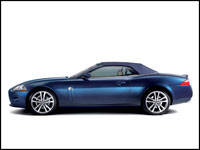 |
| For the most part, the XK Convertible is identical to the XK Coupe,with the same nose, tail and elegant midsection. (Photo: Jaguar Canada) |
While the previous generation XK Convertible wasn't exactly what I'd call a purist's sports car, mostly due to its substantial girth and flexing body structure, the new vehicle's more rigid construction, lighter curb weight, sophisticated suspension and, reportedly, communicative steering system should forge a new image for Jaguar. Some of that structural rigidity comes from extra bracing under the car's skin and, it could be said because of the aluminum skin itself. Add this to the additional electric components required for the folding soft top roof, and the weight penalty is surprisingly small at just 40 kg (88 lbs).