





These high revs also take a big toll on fuel economy, which already suffers from all-wheel-drive drive-train losses. The Ralliart will consume significantly more premium fuel than a Honda Civic Si in normal driving, but then again the Ralliart will accelerate significantly faster in wintry conditions. At 100 km/h the Ralliart spins at 2,400 RPM in 6th gear and throughout the test I observed 12.5 L/100km.
Once you reach your cruising speed and the gearbox finally upshifts to 6th, the Ralliart is surprisingly reluctant to downshift when you need to speed up a bit. A quick flick of the left paddle shifter – even when in automatic mode – gives you control.
When downshifting, the transmission quickly rev-matches and the tachometer shoots up; however, you can count more than two beats before any engine braking is felt. This tends to leave you hotter into a corner than you were planning. Thankfully the brakes step in with excellent pedal feel despite being smaller and less powerful than those on the EVO.
The stock Ralliart suspension set-up is superb for rapid cornering, but long-distance straight highway driving feels bouncy. On a final note about the dual-clutch transmission, there is a sports mode which keeps the revs even higher; but this is only really useful at the track or at an autocross, where the Ralliart will naturally shine. I would definitely opt for the five-speed manual transmission, but unfortunately this is only offered on the EVO or the regular Lancer.
Brilliant xenon HID headlamps are standard on the Ralliart and the only missing option I found myself longing for on my tester was a sunroof – which Mitsubishi asks $5,300 for as part of the technology pack. This price does include a navigation system and an improved audio system; but Mitsubishi still has the audacity to ask for another $353.89 plus installation costs to make the stock Bluetooth hands-free phone buttons actually function. Meanwhile, this Bluetooth is standard on all Ralliarts sold in the US.
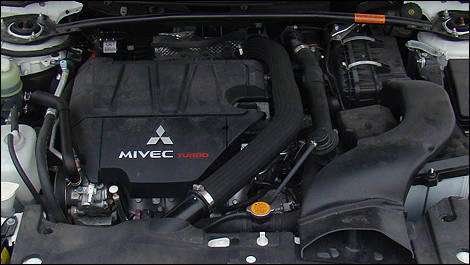 |
| At 100 km/h the Ralliart spins at 2,400 RPM in 6th gear. |
Once you reach your cruising speed and the gearbox finally upshifts to 6th, the Ralliart is surprisingly reluctant to downshift when you need to speed up a bit. A quick flick of the left paddle shifter – even when in automatic mode – gives you control.
When downshifting, the transmission quickly rev-matches and the tachometer shoots up; however, you can count more than two beats before any engine braking is felt. This tends to leave you hotter into a corner than you were planning. Thankfully the brakes step in with excellent pedal feel despite being smaller and less powerful than those on the EVO.
The stock Ralliart suspension set-up is superb for rapid cornering, but long-distance straight highway driving feels bouncy. On a final note about the dual-clutch transmission, there is a sports mode which keeps the revs even higher; but this is only really useful at the track or at an autocross, where the Ralliart will naturally shine. I would definitely opt for the five-speed manual transmission, but unfortunately this is only offered on the EVO or the regular Lancer.
Brilliant xenon HID headlamps are standard on the Ralliart and the only missing option I found myself longing for on my tester was a sunroof – which Mitsubishi asks $5,300 for as part of the technology pack. This price does include a navigation system and an improved audio system; but Mitsubishi still has the audacity to ask for another $353.89 plus installation costs to make the stock Bluetooth hands-free phone buttons actually function. Meanwhile, this Bluetooth is standard on all Ralliarts sold in the US.
 |
| The interior is simple, but this strikes at the root of the Ralliart’s spirit; it is a normal car made to into a driver’s car. |