





We don't yet have the Canadian MSRP of this model, but in the U.S., EcoBoost is about $10,000 US more than the base model, and about $4,000 US more than a comparably equipped non-EcoBoost MKS. So expect a similar spread.
Later on in the model year, you will be able to equip your EcoBoost MKS with a sport appearance package, which includes such items as front lip spoiler, rear decklid spoiler, special badging, 20-inch chrome wheels, unique Sienna leather seats and IP, unique metallic appliqué, and unique sill plates and floor mats.
EcoBoost-related upgrades
Obviously, you can't drop a monster into the engine bay without beefing up other bits. Transmission upgrades include new fluid, new torque converter, new gearset, and adjusted gear and final drive ratios.
Suspension upgrades include new front and rear stabilizer bars, revised tunings, new upper shock mounts, and stiffer front subframe mounts.
EcoBoost models are also equipped with an electric power steering (EPP) system, which lightens the load at parking lot speeds, and opens the door for two new options: Active Park Assist and Pull Drift Compensation.
Moving forward, quickly
Our first drive in the MKS EcoBoost was at Ford's proving grounds in Romeo, Michigan. Not too shabby a place for checking out handling and performance.
The banked, high-speed course is where we matted the accelerator, until the MKS hit its self-imposed limit of 135 mph, or 216 km/h.
It got there in a very controlled "whoosh."
No turbo lag. No hysterics. No tire squeal. Just hard, constant acceleration, with a snarly yet refined soundtrack.
At highway speeds, the car is extremely quiet and relaxed, thanks in part to all that sound insulation we talked about, and very tall gearing, which was possible because maximum torque is available all the way from 1,500 to 5,250 rpm. This also allows it to have very decent highway fuel economy (about 24 mpg, or 9.8 L/100 km).
That constant torque also enables you to confidently negotiate sweeping corners, hills, and twisty bits, because whatever the rpm, or the throttle inputs, torque remains relative constant, so the car stays quite balanced.
The Lincoln turns in very easily, and doesn't plow through corners. And with this engine, this means you can go really fast.
Later on in the model year, you will be able to equip your EcoBoost MKS with a sport appearance package, which includes such items as front lip spoiler, rear decklid spoiler, special badging, 20-inch chrome wheels, unique Sienna leather seats and IP, unique metallic appliqué, and unique sill plates and floor mats.
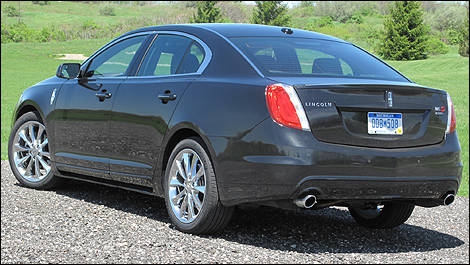 |
| We don't yet have the Canadian MSRP of this model, but in the U.S., EcoBoost is about $10,000 US more than the base model. |
EcoBoost-related upgrades
Obviously, you can't drop a monster into the engine bay without beefing up other bits. Transmission upgrades include new fluid, new torque converter, new gearset, and adjusted gear and final drive ratios.
Suspension upgrades include new front and rear stabilizer bars, revised tunings, new upper shock mounts, and stiffer front subframe mounts.
EcoBoost models are also equipped with an electric power steering (EPP) system, which lightens the load at parking lot speeds, and opens the door for two new options: Active Park Assist and Pull Drift Compensation.
Moving forward, quickly
Our first drive in the MKS EcoBoost was at Ford's proving grounds in Romeo, Michigan. Not too shabby a place for checking out handling and performance.
The banked, high-speed course is where we matted the accelerator, until the MKS hit its self-imposed limit of 135 mph, or 216 km/h.
It got there in a very controlled "whoosh."
No turbo lag. No hysterics. No tire squeal. Just hard, constant acceleration, with a snarly yet refined soundtrack.
At highway speeds, the car is extremely quiet and relaxed, thanks in part to all that sound insulation we talked about, and very tall gearing, which was possible because maximum torque is available all the way from 1,500 to 5,250 rpm. This also allows it to have very decent highway fuel economy (about 24 mpg, or 9.8 L/100 km).
That constant torque also enables you to confidently negotiate sweeping corners, hills, and twisty bits, because whatever the rpm, or the throttle inputs, torque remains relative constant, so the car stays quite balanced.
The Lincoln turns in very easily, and doesn't plow through corners. And with this engine, this means you can go really fast.
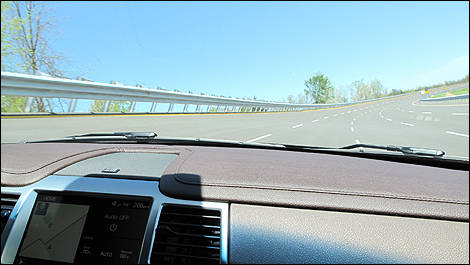 |
| That constant torque also enables you to confidently negotiate sweeping corners. |