





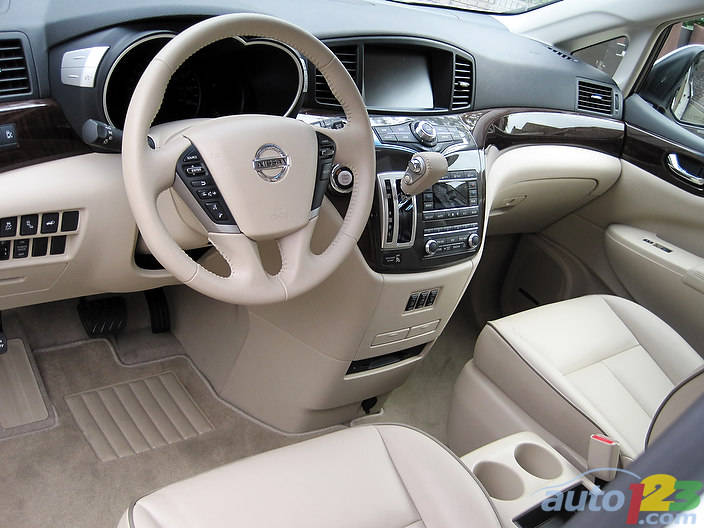
Inside, the emphasis is on comfort with warm tones and a simple, easy-to-use interface between passenger and vehicle. The upholstery in our tester was a rather utilitarian grey, but the creamy beige in other available models appeared more aesthetically pleasing. Overall, we found it comfortable if unremarkable.
Ingress is easy thanks to one of the lowest side step-ups in the industry. There are available one-touch sliding doors (although their sensitivity to obstructions could use some adjustment–they stop with enough force to knock a small child off its feet) and a one-touch power liftgate as well.
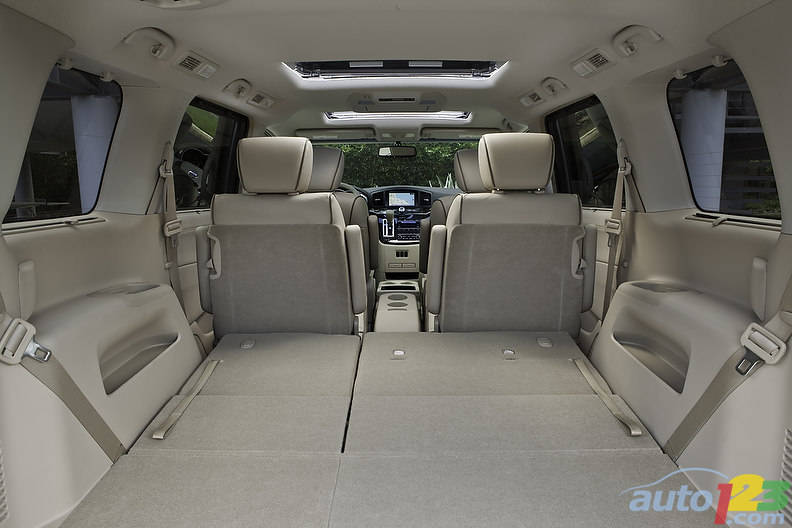
Seats are cushy and soft, and there's available leather, tri-zone climate control and a 6-way adjustable driver's seat. There's room for seven, and second and third rows are "stadium seating"–raised for better visibility. Both rows fold flat, without obstructing a rear under-floor storage area at the back of the vehicle–but they're not removable which cuts into cargo space.
Total cargo space with both rows folded is 108 cu. ft.–which lags far behind the Odyssey at 149, Chrysler at 144 and the Sedona at 142.
Although longer, the Quest has the same turning radius as the Altima it shares a platform with. Underhood is a 3.5-litre, 260-hp V6 that delivers 10% (city) and 4% (highway) better fuel economy than its predecessor. It's mated solely to a continuously variable transmission with adaptive shift control that learns the driver's style and adapts itself accordingly.
Our test drive took us along the beautiful Del Mar coastline, winding up through the twisting La Jolla Trail to the top of Mount Soledad. Tight turns produced no wallow and little roll. Smaller than its competitors, the Quest feels nimble and planted thanks to independent suspension at all four corners. The speed-sensitive steering isn't overly boosted, feels direct and connected without being too light on roadways, while not being heavy nor cumbersome during parking manoeuvres.
Navigating the convoluted San Diego freeways, we greatly appreciated the blind spot warning system, and were amused by the nav system's phonetically creative pronunciation. The Quest is very quiet, the engine unobtrusive and the transmission shifted smoothly without any of the lag so often associated with CVTs. The ride is comfortable and poised–although unlike the newest Chrysler vans, its driving dynamics are unlikely to inspire the enthusiast.
Available in Canadian showrooms at the end of January, the new Quest is available in four trims: the base S (which oddly, doesn't offer Bluetooth), SV, SL and range-topping LE. There's a large array of technology that becomes available up through the trim lines, from power doors, USB, rearview camera, heated seats, navigation, xenon headlights, Bose sound and a new tire pressure monitoring system (making its Nissan debut) that sounds a warning when air pressure capacity is reached.
Although pricing won't be announced until January, the S model should start under $30,000 (less than the previous model), the SV (expected volume seller) at around $35,000, under $40,000 for the SL and mid-$40,000 for the range-topping LE.
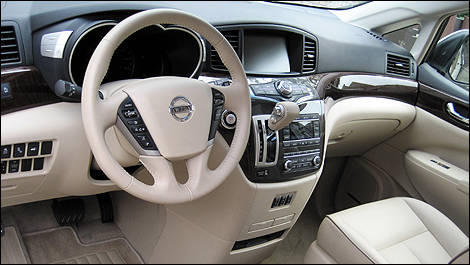 |
| Inside, the emphasis is on comfort with warm tones and a simple, easy-to-use interface between passenger and vehicle. (Photo: Lesley Wimbush/Auto123.com) |
Ingress is easy thanks to one of the lowest side step-ups in the industry. There are available one-touch sliding doors (although their sensitivity to obstructions could use some adjustment–they stop with enough force to knock a small child off its feet) and a one-touch power liftgate as well.
Seats are cushy and soft, and there's available leather, tri-zone climate control and a 6-way adjustable driver's seat. There's room for seven, and second and third rows are "stadium seating"–raised for better visibility. Both rows fold flat, without obstructing a rear under-floor storage area at the back of the vehicle–but they're not removable which cuts into cargo space.
Total cargo space with both rows folded is 108 cu. ft.–which lags far behind the Odyssey at 149, Chrysler at 144 and the Sedona at 142.
Although longer, the Quest has the same turning radius as the Altima it shares a platform with. Underhood is a 3.5-litre, 260-hp V6 that delivers 10% (city) and 4% (highway) better fuel economy than its predecessor. It's mated solely to a continuously variable transmission with adaptive shift control that learns the driver's style and adapts itself accordingly.
Our test drive took us along the beautiful Del Mar coastline, winding up through the twisting La Jolla Trail to the top of Mount Soledad. Tight turns produced no wallow and little roll. Smaller than its competitors, the Quest feels nimble and planted thanks to independent suspension at all four corners. The speed-sensitive steering isn't overly boosted, feels direct and connected without being too light on roadways, while not being heavy nor cumbersome during parking manoeuvres.
Navigating the convoluted San Diego freeways, we greatly appreciated the blind spot warning system, and were amused by the nav system's phonetically creative pronunciation. The Quest is very quiet, the engine unobtrusive and the transmission shifted smoothly without any of the lag so often associated with CVTs. The ride is comfortable and poised–although unlike the newest Chrysler vans, its driving dynamics are unlikely to inspire the enthusiast.
Available in Canadian showrooms at the end of January, the new Quest is available in four trims: the base S (which oddly, doesn't offer Bluetooth), SV, SL and range-topping LE. There's a large array of technology that becomes available up through the trim lines, from power doors, USB, rearview camera, heated seats, navigation, xenon headlights, Bose sound and a new tire pressure monitoring system (making its Nissan debut) that sounds a warning when air pressure capacity is reached.
Although pricing won't be announced until January, the S model should start under $30,000 (less than the previous model), the SV (expected volume seller) at around $35,000, under $40,000 for the SL and mid-$40,000 for the range-topping LE.
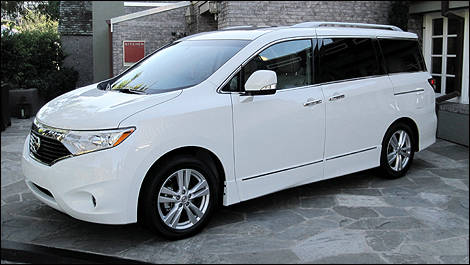 |
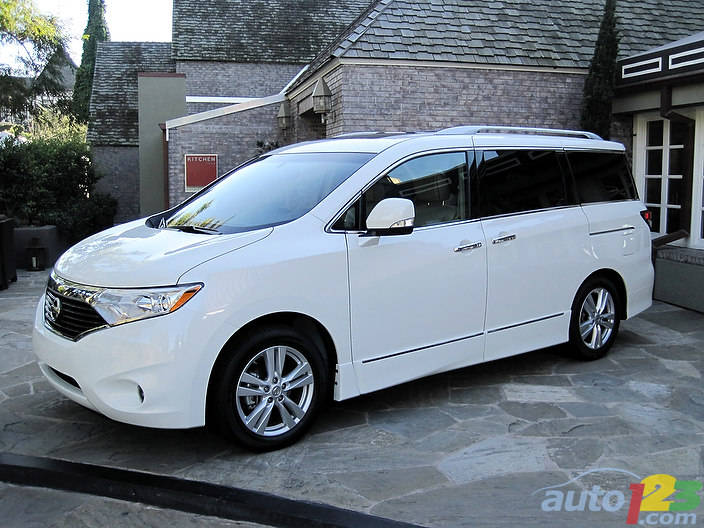
| The new Quest has embraced its segment, and is going after buyers who want minivans–complete with all their inherent quiet and comfort. (Photo: Lesley Wimbush/Auto123.com) |
Article Gallery