





The engine, too, has been quiet-tuned by a five-chamber intake manifold – the exhaust designed to move noise away and prevent it from coming up through the floor panels. The sound of the turn signals, the clicking of switchgear, everything has been engineered to create a cabin as eerily hushed as an anechoic sound chamber. Besides creating a ride that's bathed in tranquility, this serves another purpose: reducing "white noise" makes the voice-activated infotainment system that much more accurate.
Before setting out, my partner and I are briefed on Buick's Intellilink system – the on-board touch-screen, voice-activated interface that incorporates navigation, hands-free calling and streams Stitcher and Pandora (not yet available in Canada) web radio via the user's smartphone.
Using an iPhone, we searched for a Google Map location (in this case, a specialty coffee brewer) and used the "send to car" option to store the location in the system's database. Even I, a self-professed gadget-phobe, had to admit that it worked like a charm. Straightforward, without any showy video-game silliness, this system's interface is useful without being distracting.
Next, we tried the OnStar turn-by-turn navigation, which worked flawlessly but left us wondering what sort of happy pills those operators must be taking (and whether we could get some).
The Verano makes absolutely no claims to sportiness. Steering is accurate, never too light nor too heavy, but there's very little feedback. It handles the winding roads and rough surfaces very well, never losing its composure and without an undue amount of body roll. There's a nice solid feel to it through the curves and ascending loops, even over the hard-scrabble concrete.
But it isn't quick. Underhood, the 2.4L 4-cylinder Ecotec engine delivers 180 horsepower. It's mated to a 6-speed automatic transmission that's engineered for fuel economy rather than fun; several times it lagged on downshifts when pushed. There are no paddle shifters, but knocking the shift lever to one side enables driver-selectable gear shifting.
Passing one of the many logging trucks we encountered required plenty of forethought (and room). There just isn't enough oomph under the hood to make last-minute, reflex-quick passing manoeuvres. Designed for tranquility and frugality, the Verano reports 6.4L/100km fuel economy during highway driving.
Next year's plans include the addition of a 250-hp turbocharged engine – which should go nicely with the Verano's solid body and suspension. Overall, the Verano delivers exactly as promised, quiet luxury combined with an economy of scale.
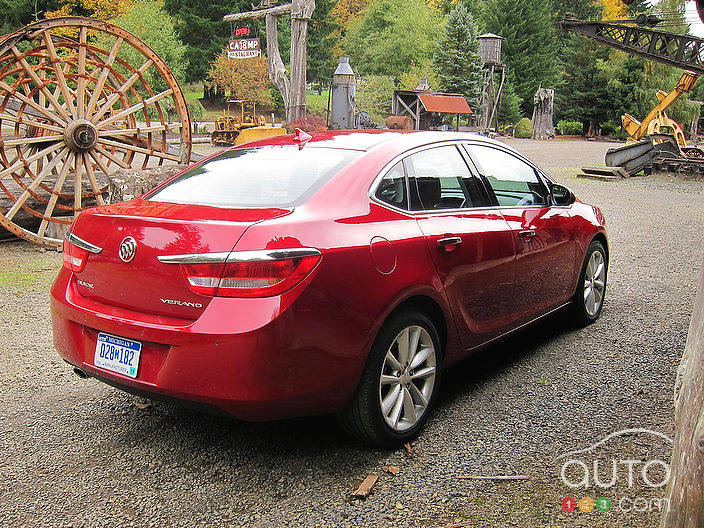
Offered in four trims, it will appear in Canadian showrooms later this year, starting at $22,595.
Before setting out, my partner and I are briefed on Buick's Intellilink system – the on-board touch-screen, voice-activated interface that incorporates navigation, hands-free calling and streams Stitcher and Pandora (not yet available in Canada) web radio via the user's smartphone.
Using an iPhone, we searched for a Google Map location (in this case, a specialty coffee brewer) and used the "send to car" option to store the location in the system's database. Even I, a self-professed gadget-phobe, had to admit that it worked like a charm. Straightforward, without any showy video-game silliness, this system's interface is useful without being distracting.
Next, we tried the OnStar turn-by-turn navigation, which worked flawlessly but left us wondering what sort of happy pills those operators must be taking (and whether we could get some).
The Verano makes absolutely no claims to sportiness. Steering is accurate, never too light nor too heavy, but there's very little feedback. It handles the winding roads and rough surfaces very well, never losing its composure and without an undue amount of body roll. There's a nice solid feel to it through the curves and ascending loops, even over the hard-scrabble concrete.
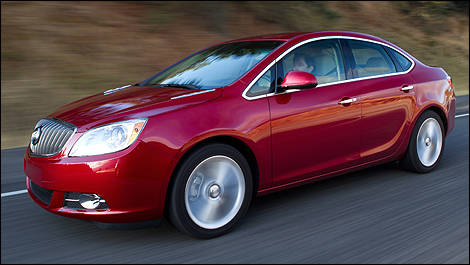 |
| Offered in four trims, it will appear in Canadian showrooms later this year, starting at $22,595. (Photo: General Motors) |
But it isn't quick. Underhood, the 2.4L 4-cylinder Ecotec engine delivers 180 horsepower. It's mated to a 6-speed automatic transmission that's engineered for fuel economy rather than fun; several times it lagged on downshifts when pushed. There are no paddle shifters, but knocking the shift lever to one side enables driver-selectable gear shifting.
Passing one of the many logging trucks we encountered required plenty of forethought (and room). There just isn't enough oomph under the hood to make last-minute, reflex-quick passing manoeuvres. Designed for tranquility and frugality, the Verano reports 6.4L/100km fuel economy during highway driving.
Next year's plans include the addition of a 250-hp turbocharged engine – which should go nicely with the Verano's solid body and suspension. Overall, the Verano delivers exactly as promised, quiet luxury combined with an economy of scale.
Offered in four trims, it will appear in Canadian showrooms later this year, starting at $22,595.
Article Gallery