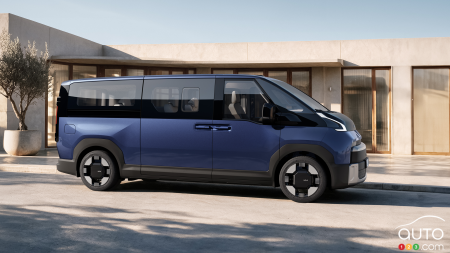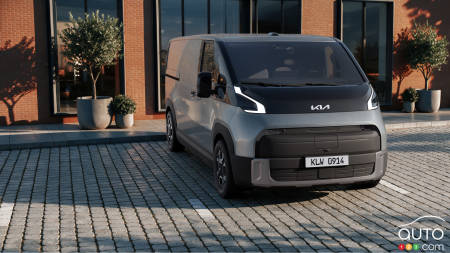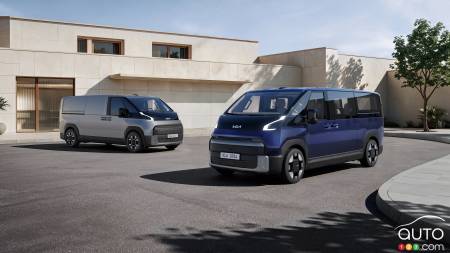



Kia continues its entry into the commercial electric vehicle market with the unveiling of the PV7. Presented at the 2026 IAA Transportation show in Hanover, Germany, this new van is the second model in the South Korean automaker's Platform Beyond Vehicle (PBV) lineup, after the PV5.
Larger than the PV5, the Kia PV7 will be offered in Cargo and Passenger versions. Commercial sales are set to begin in South Korea and Europe during the second half of 2027. For now, Kia has not confirmed its availability in Canada.
Two batteries and 800-volt charging
The PV7 rests on the E-GMP.S architecture developed specifically for PBV lineup vehicles. This platform stands out in particular for its flat floor and modular design, which will allow Kia to offer a wide variety of configurations.
Two nickel-cobalt-manganese batteries will be offered, with capacities of 71.5 and 96.2 kWh. Depending on the version and market, the electric motor will deliver up to 200 kW, or roughly 268 hp.
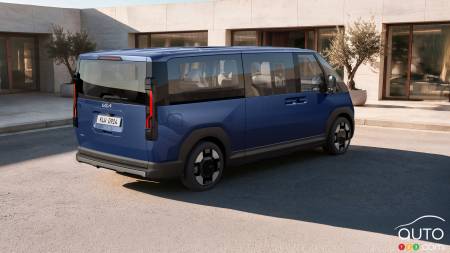
Front-wheel drive will come standard; an all-wheel-drive variant is set to join the lineup at a later date. Kia estimates the PV7 Cargo Long Range will be able to travel over 460 km on a full charge, according to the European WLTP cycle. This figure remains preliminary, however, and must be confirmed following the homologation process.
Thanks to the PV7’s 800-volt electrical architecture, the battery can be charged from 10 to 80 percent in roughly 20 minutes on a 350-kW fast charger. The PV7 will also introduce a dual charge-port configuration for Kia. An AC/DC socket will be positioned at the front, while a second AC socket can be added at the rear to facilitate charging in various parking setups.
The V2L bidirectional power supply function will also allow tools or equipment to be plugged directly into the vehicle.
Up to eight cubic metres of cargo space
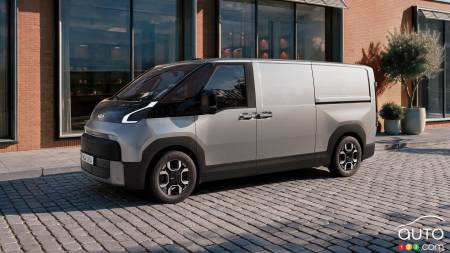
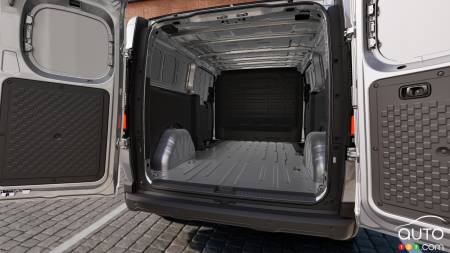
Aimed in particular at delivery services and fleet managers, the PV7 Cargo will be available with two or three seats up front. In its long configuration, it will offer a maximum cargo volume of 6.1 cubic metres. That figure will climb to 8 cubic metres with the high roof.
Payload capacity will reach 1,165 kg for the long model and 1,200 kg for the compact version. The loading sill of the PV7 Cargo Long will sit at 550 mm, while the rear cargo area will be able to accommodate up to three Euro pallets.
Buyers will be able to choose between two rear barn doors and a conventional tailgate. A drive mode designed for heavy loads will also adjust vehicle behaviour based on the weight being carried.
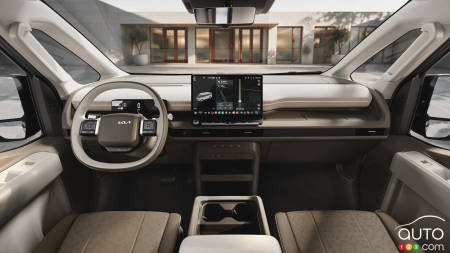
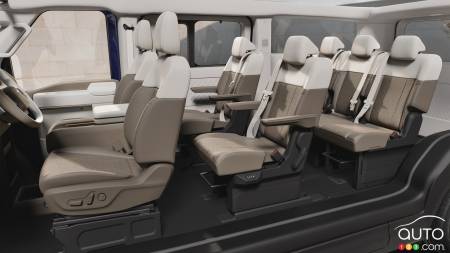
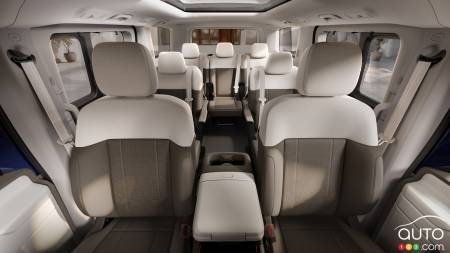
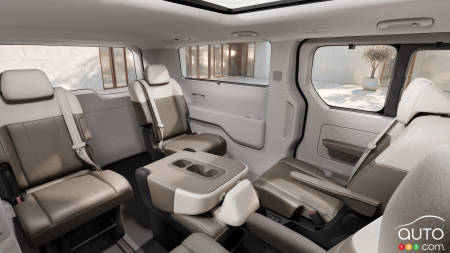
For its part, the PV7 Passenger will be able to accommodate up to nine occupants in international markets and up to 11 in South Korea. Kia notably plans 7- and 9-seat configurations. Seats mounted on long rails can be removed to quickly adapt the cabin for carrying passengers or cargo.
A lineup set to expand
Measuring 5,350 mm in length with a 3,500-mm wheelbase, the PV7 adopts an upright silhouette aimed at maximizing interior space. The dashboard groups 12.9- and 14.6-inch screens, while the Pleos Connect system runs on Android Automotive OS.
The automaker eventually plans to offer the PV7 in no fewer than 23 variants. Compact, long and high-roof Cargo models are planned, as well as Passenger versions and chassis-cabs intended for specialized conversions.
Kia is also counting on connected services for fleet management, remote monitoring and predictive maintenance. The PV7 will be followed by the PV9, another, even larger commercial electric vehicle slated to arrive in 2029.