





From there, we realized, through Audi peeps of course, that standardization has become a huge issue. Or will be if nothing is done in the short term. As Audi is deeply involved and committed to this technology, they have offered insight and input from charging and charging infrastructures to cell geometry (limiting the number of available sizes to keep production costs down). And it will all pay off.
To that first point, Audi has developed a genial system where a battery can be charged through induction; no need to pull out a huge cable and mess around with little flaps or doors and plugging stuff in. Essentially, all the owner of a PHEV (rechargeable hybrid) or an EV has to do is park over a plate in the ground.
Types of charging were also on the docket what with voltages (the energy that makes the electrical current flow in a circuit) varying from country to country. The amount of flow influences charging times wildly, from over 12 hours to as little as a half hours, for a full charge.
We were also given a tour of Audi's 125,000,000-euro installation called the Aggregate Centre. This ginormous building houses all the phases through which the development of hybrid, EV and the likes' batteries go through. The components are designed, built, developed, tested and evaluated in numerous test situations (climate-controlled chambers being one such test) before they ever go out on the road. The facilities are beyond impressive and make me wish I was smarter and had become an engineer...
We were then given the opportunity to go for a ride (proper test drive these were not) with three very distinct vehicles, all issued from the Electromobility program.
Over the next week, I will chronicle my experiences with these three products, attempt to describe what they are and what we consumers, can expect from them.
To that first point, Audi has developed a genial system where a battery can be charged through induction; no need to pull out a huge cable and mess around with little flaps or doors and plugging stuff in. Essentially, all the owner of a PHEV (rechargeable hybrid) or an EV has to do is park over a plate in the ground.
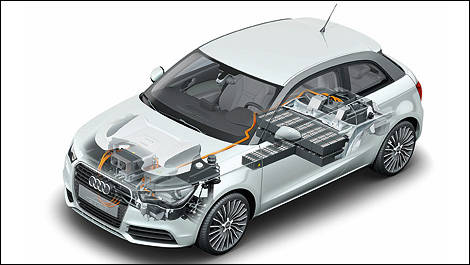 |
| Photo: Audi |
Types of charging were also on the docket what with voltages (the energy that makes the electrical current flow in a circuit) varying from country to country. The amount of flow influences charging times wildly, from over 12 hours to as little as a half hours, for a full charge.
We were also given a tour of Audi's 125,000,000-euro installation called the Aggregate Centre. This ginormous building houses all the phases through which the development of hybrid, EV and the likes' batteries go through. The components are designed, built, developed, tested and evaluated in numerous test situations (climate-controlled chambers being one such test) before they ever go out on the road. The facilities are beyond impressive and make me wish I was smarter and had become an engineer...
We were then given the opportunity to go for a ride (proper test drive these were not) with three very distinct vehicles, all issued from the Electromobility program.
Over the next week, I will chronicle my experiences with these three products, attempt to describe what they are and what we consumers, can expect from them.