





Descending to the lower levels, we wander through corridors, some containing boxes of parts stacked along the walls. Our guide explains how technology has made easy the creation of prototype parts; what was once an exorbitantly expensive process involving time-consuming tooling is now relatively quick, thanks to laser beam and liquid plastic or powdered steel. This process is not only less expensive and faster, it's also much easier to correct any errors.
We're led to a large window overlooking the crash test chamber. Inside, a large sled on rails carries either a car, or simply secured seats with dummies. Twice a day, the device is activated by gunpowder firing a piston – exploding the sled forward to speeds of up to 84 km/h.
Overhead, high speed cameras shoot thousands of pictures. This particular device isn't for crashing cars, but rather for testing restraints – seat belts, seats, and the security of roof racks when the sled is rammed into the carrier. Inexplicably, the dummies, which range from child to adult male, are all clad in pink underwear.
Next, we're led to a chassis test simulator – a platform on which the car is subjected to the same pounding it would receive from 10,000 km driven on the Nurburgring. BMW believes that cars should last for at least 300,000 km, so the testers spend at least 100 hours on the platform, with temperatures ranging from -40 to 80 degrees Celsius, and another two weeks in x-ray and analysis.
Somewhere deep in the bowels of the building, we're shown to a room containing a bare chassis with a lithium battery pack fastened to its bottom. In the corner of the room, our guide sweeps a tarp away from a rather odd-looking shell. We're delighted to learn that we're looking at the carbon-fibre cockpit of the new BMW i3 electric car.
BMW formed a joint venture with SGL Group to produce carbon fibre on a large scale at a new state-of-the-art plant in Washington. The first mass-produced car to have a carbon fibre passenger cell, the i3's resulting low body weight will more than offset the heaviness inherent in battery-pack energy storage, thus helping to increase range and reduce energy consumption.
Carbon fibre monocoques are immensely strong, providing a stiff and virtually unbreakable safety cell. Aluminum crumple zones at the front of the vehicle will absorb any impact in the event of a collision.
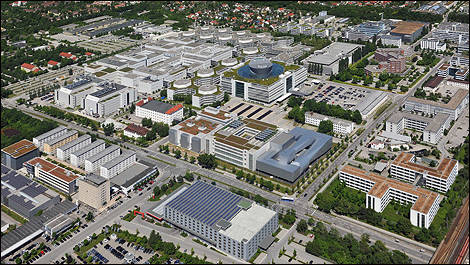
Back in the atrium, we notice the casual mingling of "suits" with more free-spirited design types – as far as dress code is concerned, it appears that anything goes. For the 8,000 people who work here, 4,000 of them engineers, it appears to be a congenial atmosphere. Socializing between departments is encouraged, there's a tearing down of walls that's not only just a figure of speech.
We're led to a large window overlooking the crash test chamber. Inside, a large sled on rails carries either a car, or simply secured seats with dummies. Twice a day, the device is activated by gunpowder firing a piston – exploding the sled forward to speeds of up to 84 km/h.
Overhead, high speed cameras shoot thousands of pictures. This particular device isn't for crashing cars, but rather for testing restraints – seat belts, seats, and the security of roof racks when the sled is rammed into the carrier. Inexplicably, the dummies, which range from child to adult male, are all clad in pink underwear.
 |
| Photo: BMW |
Next, we're led to a chassis test simulator – a platform on which the car is subjected to the same pounding it would receive from 10,000 km driven on the Nurburgring. BMW believes that cars should last for at least 300,000 km, so the testers spend at least 100 hours on the platform, with temperatures ranging from -40 to 80 degrees Celsius, and another two weeks in x-ray and analysis.
Somewhere deep in the bowels of the building, we're shown to a room containing a bare chassis with a lithium battery pack fastened to its bottom. In the corner of the room, our guide sweeps a tarp away from a rather odd-looking shell. We're delighted to learn that we're looking at the carbon-fibre cockpit of the new BMW i3 electric car.
BMW formed a joint venture with SGL Group to produce carbon fibre on a large scale at a new state-of-the-art plant in Washington. The first mass-produced car to have a carbon fibre passenger cell, the i3's resulting low body weight will more than offset the heaviness inherent in battery-pack energy storage, thus helping to increase range and reduce energy consumption.
Carbon fibre monocoques are immensely strong, providing a stiff and virtually unbreakable safety cell. Aluminum crumple zones at the front of the vehicle will absorb any impact in the event of a collision.
Back in the atrium, we notice the casual mingling of "suits" with more free-spirited design types – as far as dress code is concerned, it appears that anything goes. For the 8,000 people who work here, 4,000 of them engineers, it appears to be a congenial atmosphere. Socializing between departments is encouraged, there's a tearing down of walls that's not only just a figure of speech.