





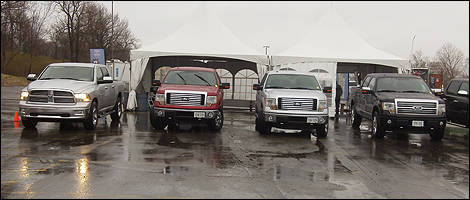
During the Built Ford Tough event held in Montreal, one of several Canadian cities the tour has or will cover, we were invited to a towing test between the F-150 EcoBoost, the Chevrolet Silverado with a 5.3L V8 and the Ram 1500 with its 5.7L HEMI V8. The turbo V6 effortlessly pulled its 6,600-lb trailer around, although one of two F-150s we drove displayed a slightly annoying tugging sensation; the other Ford didn’t, and neither did the competitors. Oh well.
If there’s one area where the EcoBoost lacks compared to a good ol’ V8, it’s engine sound. The blown V6 is no match for the HEMI’s raging roar and Ford’s own 6.2L unit. Whether that’s an important purchase factor or not is up to you.
As for fuel economy, the EcoBoost seemed to guzzle less of it than the others while pulling trailers (all were above 20 L/100 km), but while driving unloaded, we’ll have to judge when we get the F-150 EcoBoost for a road test in a couple of weeks.
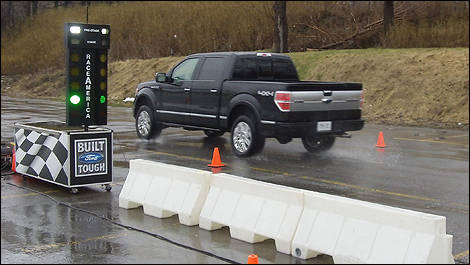
We also performed several acceleration runs aboard F-150s with all four engines as well as with the aforementioned competitors. The 3.7L V6 performs well for a base engine and is a worthy replacement for Ford’s old 4.6-litre V8. As for the EcoBoost, it seemed to lag at blastoff compared to the V8s, unless we brake-torqued it at around 1,500 rpm.
In this very-competitive segment, don’t be surprised to see General Motors or Chrysler up the ante as soon as next year. Meanwhile, Ram’s answer to the EcoBoost and its greater fuel economy seems to be the addition of lower-priced versions equipped with the HEMI, such as the Ram 1500 Express.
Here’s where I become the party pooper. The EcoBoost engine costs $1,000 more than the 5.0-litre V8. If you drive 20,000 km annually, and if gas costs $1.50 a litre, it will take 2¾ years before you start saving money.
In short, who’s got the best pickup engine line-up? For now, it’s Ford.
 |
| Photo: Michel Deslautiers/Auto123.com |
If there’s one area where the EcoBoost lacks compared to a good ol’ V8, it’s engine sound. The blown V6 is no match for the HEMI’s raging roar and Ford’s own 6.2L unit. Whether that’s an important purchase factor or not is up to you.
As for fuel economy, the EcoBoost seemed to guzzle less of it than the others while pulling trailers (all were above 20 L/100 km), but while driving unloaded, we’ll have to judge when we get the F-150 EcoBoost for a road test in a couple of weeks.
We also performed several acceleration runs aboard F-150s with all four engines as well as with the aforementioned competitors. The 3.7L V6 performs well for a base engine and is a worthy replacement for Ford’s old 4.6-litre V8. As for the EcoBoost, it seemed to lag at blastoff compared to the V8s, unless we brake-torqued it at around 1,500 rpm.
In this very-competitive segment, don’t be surprised to see General Motors or Chrysler up the ante as soon as next year. Meanwhile, Ram’s answer to the EcoBoost and its greater fuel economy seems to be the addition of lower-priced versions equipped with the HEMI, such as the Ram 1500 Express.
Here’s where I become the party pooper. The EcoBoost engine costs $1,000 more than the 5.0-litre V8. If you drive 20,000 km annually, and if gas costs $1.50 a litre, it will take 2¾ years before you start saving money.
In short, who’s got the best pickup engine line-up? For now, it’s Ford.
 |
| Photo: Michel Deslautiers/Auto123.com |