






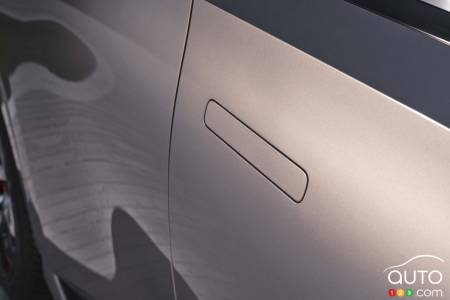
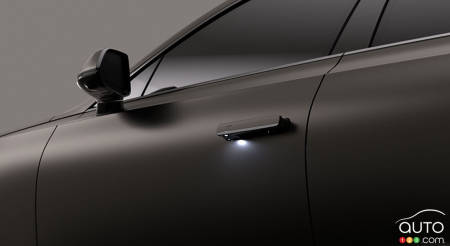
For several years, flush door handles — those that retract and blend into the bodywork when not needed — have been de rigueur items on any futuristic design study, and found their way into production vehicles as well. Popularized by Tesla in the early 2010s and adopted by numerous manufacturers since, recessing handles are now in the crosshairs of Chinese regulators for safety reasons.
As of January 1st, 2027, if the draft standards are confirmed, they will be prohibited on all new vehicles sold in China. The decision could significantly alter the current approach to automotive design.
A mandatory manual mechanism
The new regulation from the Chinese Ministry of Industry and Information Technology requires that every door, with the exception of the tailgate, be equipped with a mechanism accessible even in the event of an electrical failure or serious collision. It will no longer be enough to press a button or rely on an electric motor to open a door if the electronic systems fail. While this principle seems logical, the majority of current flush handles don’t have such a mechanism.
Safety first
Obviously, one of the primary motives for the regulatory change is safety. There have been reports of accidents in which occupants as well as first responders, were unable to open the doors after an impact because the motorized handles no longer functioned. In some recent cases involving Chinese SUVs, witnesses described the impossibility of opening doors manually, even after breaking a window, as no lever was visible or accessible.

Practical limits and aerodynamics
Beyond accidents, Chinese regulators highlight other constraints: the handles can freeze shut in cold weather (notably due to ice) and are vulnerable to battery failures. What’s more, according to certain internal studies, they offer only a negligible aerodynamic advantage. In terms of energy efficiency, the actual impact on a vehicle's range is often less than a fraction of a kilowatt-hour per 100 km.
A global impact
For manufacturers, this means that models already on the market will need to be revised. Tesla, which has made these handles its signature, has already acknowledged the problem and is working on solutions combining electronic controls and integrated mechanical functions. Chinese authorities are not the only ones concerned: officials in Europe, the U.S. and Canada are also examining new safety standards that could take inspiration from this approach.
The effect of China’s decision will likely reach beyond the country’s borders. China has become the world's largest automotive market and a nerve centre for global production. If brands must adapt their models to meet these requirements, it’s likely these modified versions will also be destined for export to optimize production lines.
The era of "invisible" handles could thus be coming to an end. What was perceived as a symbol of modernity could be relegated to the rank of a simple aesthetic gadget, sacrificed for the sake of user safety and the efficiency of rescue operations.