





To ensure that the C5's steering system is intuitive and ergonomic, Citroen's engineers have placed two sets of controls on the left and right
hand sides of the steering wheel. This allows the driver to accelerate, brake, or maintain speed while operating the vehicle's other controls, such as headlights, horn, turn signals, as well as stereo and climate control. As proven by its studies, this new system of throttle and brake control is easy to use, and while it's different than the conventional gas and brake pedal, Citroen claims that drivers feel comfortable after spending just a short amount of time behind the wheel.
Considering that half the steering wheel is missing, the C5-by-Wire is slightly different to steer than normal vehicles. Drawing from its parts bin, Citroen used electrical power steering to replace the conventional hydraulic pump and mechanism for the C5's steering system. Not only does the electric motor power the rack, but it also adjusts the steering wheel to wheel angle ratio, according to the driver's input and the vehicle's speed. This means that a quarter turn on the steering wheel won't always equal to a quarter turn in all circumstances. The system is capable at generating a turn ratio of 3:1, which means that for every three turns of the wheel in a normal car are closer to one turn of the C5's quasi steering wheel. Aside from eliminating aggressive arm-over-arm maneuvers which can be quite dangerous during driving, the system makes parking and low-speed cornering easier, while keeping the steering pin-sharp at higher speeds.
There's no denying that the C5's Fly-by-Wire system is an innovation in technology, but part of the drive to develop it was for safety reasons. While the steering wheel provides greater visibility of the instrumentation and the road ahead, more importantly, it does not have a metal steering column which can intrude into the cockpit, causing serious injury. The removal of the pedals offers similar benefits: reduced risk of foot and leg injury should a serious collision occur. The Fly-by-Wire system also has other active safety benefits, helping the driver to focus on the road, as
well as reducing overall braking distances by eliminating the reach for the brake pedal during accident avoidance or panic stops saving precious time and distance.
While the C5-by-Wire focuses on passive collision safety and improved driver ergonomics, this kind of technology won't be showing up on production cars for at least another five to ten years. Ground breaking leaps forward often come at a price: as we've already seen with Mercedes-Benz and the massive product range wide Brake-By-Wire recall, there is still one last hurdle for Citroen to bypass: a failsafe mechanism. Without any in place, a failure of any electrical system could prove to be catastrophic. The initial developments as seen in the C5-by-Wire are present but, it will still be some while before all systems are truly go with Fly-by-Wire for cars.
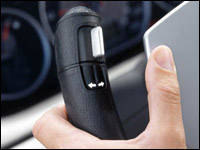 |
| the C5-by-Wire is slightly different to steer than normal vehicles. (Photo: Citroën Automobiles) |
Considering that half the steering wheel is missing, the C5-by-Wire is slightly different to steer than normal vehicles. Drawing from its parts bin, Citroen used electrical power steering to replace the conventional hydraulic pump and mechanism for the C5's steering system. Not only does the electric motor power the rack, but it also adjusts the steering wheel to wheel angle ratio, according to the driver's input and the vehicle's speed. This means that a quarter turn on the steering wheel won't always equal to a quarter turn in all circumstances. The system is capable at generating a turn ratio of 3:1, which means that for every three turns of the wheel in a normal car are closer to one turn of the C5's quasi steering wheel. Aside from eliminating aggressive arm-over-arm maneuvers which can be quite dangerous during driving, the system makes parking and low-speed cornering easier, while keeping the steering pin-sharp at higher speeds.
There's no denying that the C5's Fly-by-Wire system is an innovation in technology, but part of the drive to develop it was for safety reasons. While the steering wheel provides greater visibility of the instrumentation and the road ahead, more importantly, it does not have a metal steering column which can intrude into the cockpit, causing serious injury. The removal of the pedals offers similar benefits: reduced risk of foot and leg injury should a serious collision occur. The Fly-by-Wire system also has other active safety benefits, helping the driver to focus on the road, as
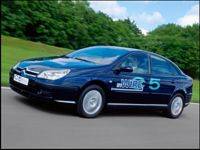 |
| The C5-by-Wire's technology won't be showing up on production cars for at least five to ten years. (Photo: Citroën Automobiles) |
While the C5-by-Wire focuses on passive collision safety and improved driver ergonomics, this kind of technology won't be showing up on production cars for at least another five to ten years. Ground breaking leaps forward often come at a price: as we've already seen with Mercedes-Benz and the massive product range wide Brake-By-Wire recall, there is still one last hurdle for Citroen to bypass: a failsafe mechanism. Without any in place, a failure of any electrical system could prove to be catastrophic. The initial developments as seen in the C5-by-Wire are present but, it will still be some while before all systems are truly go with Fly-by-Wire for cars.