





''We knew from the start that we would do it right or not do it at all,'' says Lori Queen, vehicle line executive for GM's small cars. ''The support for that decision came from the very top, and it has been an experience whereby the size and strength of GM was mobilized on a global scale to get the job done immediately.''
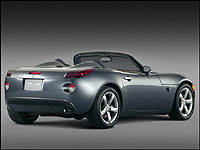 |
| When it came to the Solstice, GM said, "We knew from the start that we would do it right or not do it at all." (Photo: General Motors of Canada) |
To maintain what Queen calls the Solstice concept's ''aggressive stance, the chassis was developed to support the vehicle's short overhangs, long wheelbase and wide stance. This 'wheels at the corners' design enhances handling and the overall feeling of stability. It also allows for a more comfortable interior, with increased legroom and hip room.''
For a stiff foundation, Kappa got hydro-formed frame rails that run the length of the vehicle, along with a tube chassis and additional stampings where needed.
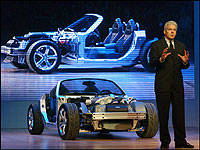 |
| The Kappa architecture's rigid structure permits more precision when it comes to tuning the suspension. (Photo: General Motors of Canada) |
The tunnel at the center of the chassis that houses the transmission and driveshaft is enclosed at the bottom to enhance stiffness, Queen explains, pointing out that ''This built-in strength reduces chassis flex and cowl shake in a vehicle designed from the outset as a convertible.''
Queen says the Kappa architecture's rigid structure also permits more precision when it comes to tuning the suspension, and its suspension design and geometry are not shared with any other GM architecture.