





• A British study shows that EV batteries last longer than gas vehicles, on average.
Among all the fears some people express regarding electric vehicles, the one concerning battery life is possibly the most significant, serving to justify their decision to postpone buying an electric model.
This is understandable, as people know that replacing a battery can be very expensive, and they fear having to pay a significant amount when their model is older.
We know that manufacturers guarantee their batteries for eight years in the vast majority of cases. Recyclers have already told us that the lifespan of an electric vehicle battery could easily be double that period.

20 years for EV batteries, 14 years for gas vehicles
A new study supports these claims. According to Geotab, a British firm specialising in automotive telematics, most electric vehicle batteries can last 20 years. That's six years longer than the average age of vehicles in the United States, which is 14 years.
Declining performance
Of course, long-term battery capacity loss must be considered. The study calculates that degradation is about 1.8 percent per year. Thus, after 10 years, about 18 percent of battery capacity is lost on average. The percentage is 27 percent after 15 years, and 36 percent after 20 years. With an EV offering 500 km when new, one can thus expect to garner 410 km after 10 years, 320 km after 20 years. That data comes from the analysis of over 10,000 electric vehicles.
As for problems that can be encountered with a battery (a breakdown, a failure), the rate for batteries manufactured over the last 10 years is less than 0.5 percent. Obviously, that can vary depending on where you live on the planet and how you use and maintain your EV, but it gives you an idea.
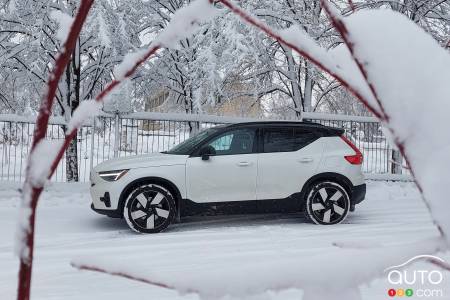
The first years are the hardest for batteries
Interestingly, the study finds that the most significant degradation occurs during the first few years of a battery's life, but it then diminishes, before picking up again towards the end of the battery's life.
Hot climates also increase battery degradation. By keeping your electric vehicle in the shade, when possible, especially during charging, you help extend its lifespan.
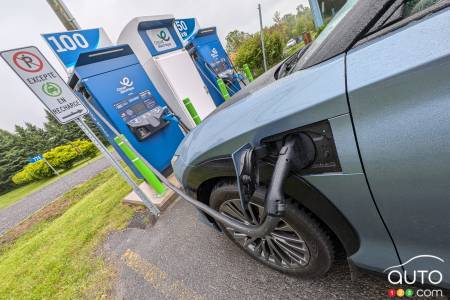
Fast charging leads to faster wear
DC fast charging increases the degradation rate compared to slow Level 1 and Level 2 charging, but experts consider the difference to be marginal.
And as InsideEVs points out, “Keeping the state of charge between 20% and 80% on nickel-manganese-cobalt (NMC) and nickel-cobalt-manganese (NCM) batteries is also a sure way to prolong battery life. On lithium-iron-phosphate (LFP) batteries, this limitation generally doesn’t apply, but one study found that constantly topping off an LFP pack could potentially reduce its lifespan.”