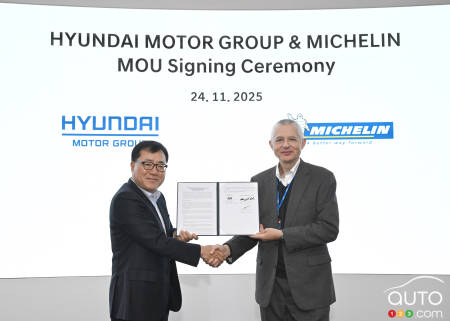



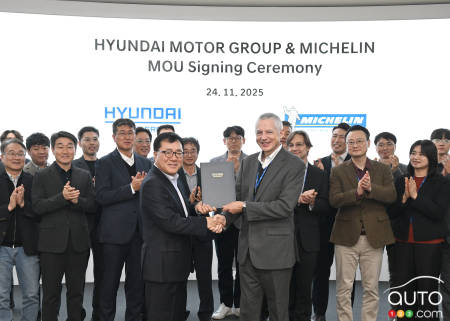
Hyundai and Michelin have just signed a third collaboration agreement aimed at redefining the standards for Electric Vehicle (EV) tires. The new three-year Memorandum of Understanding (MOU), which follows their partnership initiated in 2017, seeks to address the growing technical challenges imposed by electromobility.
It was under the existing agreement that Michelin created the dedicated tires for the all-electric Ioniq 5.
Technical constraints
Electric cars impose very specific demands on tires. Their superior mass, attributable to the batteries and chassis reinforcement, requires increased load capacity and durability. The instantaneous torque characteristic of electric motors demands greater grip, particularly during acceleration and braking.
The question that fuels engineers' passion is: how can one reconcile low rolling resistance, which is essential for preserving range, with optimal grip to guarantee safety?
Faced with that and other challenges, the two partners will develop two distinct ranges:
- • Ultra-low rolling resistance tires to maximize mileage between charges.
- • High-performance tires focused on handling and safety during demanding manoeuvres.
SmartGrip technology will be integrated to improve braking while limiting energy consumption.
Digital Innovation
The partnership is also focusing on virtual development with an innovative concept: the Embedded Tire Digital Twin. This virtual replica allows the simulation of tire behaviour in various conditions, including off-road, even before manufacturing. The result: reduced time-to-market and significant savings on physical testing.
The real-time monitoring system will analyze not only temperature and pressure but also wear and friction based on the road environment, offering much more precise tracking than current tests.
The ecological aspect is not overlooked. Hyundai and Michelin plan to significantly increase the proportion of renewable or recycled materials in tire design, rising from approximately 20 percent currently to 50 percent of the total weight. The goal is to extend tire life while minimizing tires’ environmental footprint.
Acoustic comfort is another of the priorities that will be worked on. The new tires are expected to reduce noise and vibrations at high speeds, a crucial element in electric vehicles where the silent cabin amplifies sounds.
The new-generation tires that come out of this partnership will equip future high-end models from Hyundai, Kia and Genesis.